





What's Happening?
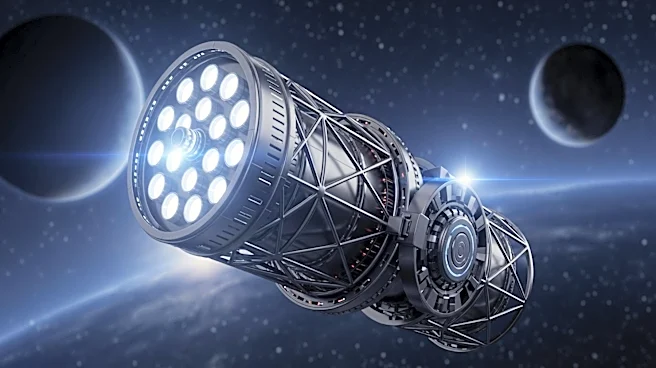
Astronomers using the James Webb Space Telescope (JWST) have discovered significant differences in the atmospheric conditions between the dawn and dusk regions of the exoplanet WASP-121 b. These regions, known as terminators, mark the transition between the planet's
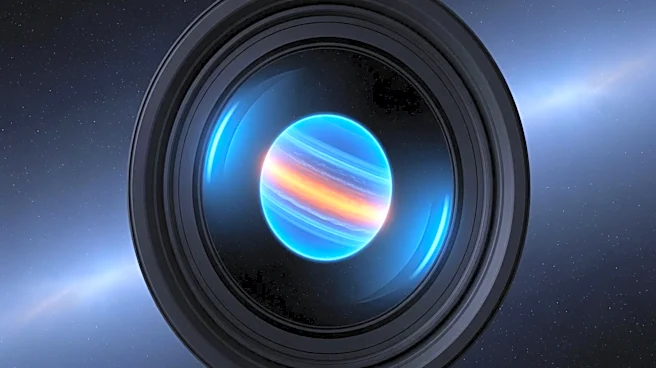
permanent day side and night side. The study revealed that the evening terminator absorbs more light than the morning terminator, suggesting differences in temperature and atmospheric composition. This discovery was made by analyzing infrared starlight passing through the planet's atmosphere during its transit in front of its host star. The findings confirm theoretical models predicting such atmospheric asymmetries, attributed to powerful winds transporting heat from the hot day side to the cooler night side.
Why It's Important?
This discovery is significant as it provides the clearest evidence yet of atmospheric differences on exoplanets, enhancing our understanding of their atmospheric dynamics. The findings could have broader implications for the study of exoplanets, particularly those with extreme conditions like WASP-121 b. By understanding how heat and chemicals are distributed across these planets, scientists can better model their atmospheres and predict their behavior. This research also demonstrates the capabilities of the JWST in providing detailed insights into distant worlds, potentially leading to new discoveries about the formation and evolution of exoplanets.
What's Next?
Future research will likely focus on refining atmospheric models to account for the observed discrepancies, such as the potential presence of mineral clouds that could affect temperature readings. The researchers plan to apply similar observational techniques to other ultra-hot gas giants to compare atmospheric conditions across different exoplanets. This could lead to a deeper understanding of the three-dimensional structures of these planets' atmospheres and their overall climate systems.
Beyond the Headlines
The study highlights the challenges of modeling exoplanet atmospheres, particularly in accounting for complex processes like cloud formation and heat transport. The potential presence of mineral clouds, unlike Earth's water-based clouds, adds a layer of complexity to these models. As technology and observational techniques improve, scientists may uncover more about the diverse atmospheric phenomena occurring on exoplanets, contributing to our broader understanding of planetary science.