





What's Happening?
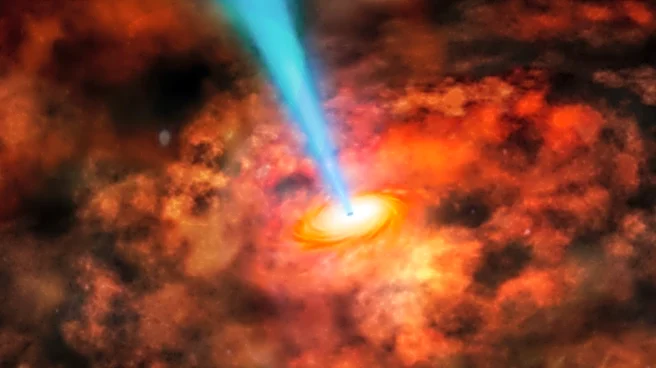
Astronomers have discovered a universal rule governing when black holes, regardless of their size, launch powerful jets into space. Research led by Dr. Adelle Goodwin of Curtin University’s International Centre of Radio Astronomy Research (ICRAR) and
co-authored by Dr. Andrew Mummery of the Institute for Advanced Study in Princeton, indicates that both stellar-mass black holes and supermassive black holes activate jets when their feeding rate drops to approximately 2 percent of the Eddington limit. This threshold was previously known for smaller black holes in the Milky Way, and its identification in supermassive black holes, observed through tidal disruption events, suggests a consistent physical mechanism across an extraordinary range of black hole masses. Tidal disruption events, where a star is torn apart by a black hole's gravity, allow astronomers to observe rapid changes in a supermassive black hole's feeding behavior over a few years, a process that would otherwise take millennia to unfold.
Why It's Important?
This discovery is fundamentally important for understanding the physics of black holes and their influence on galaxies. The finding that black holes of vastly different masses adhere to the same jet-triggering mechanism implies a universal principle in accretion physics, suggesting that the absolute mass of a black hole is less critical than its feeding rate in determining jet formation. These powerful jets, described as 'black hole burps,' can blast material across immense distances, significantly impacting the evolution and environment of the galaxies they inhabit. By identifying a critical feeding rate, astronomers can better predict when these energetic events are likely to occur, which is crucial for optimizing the use of limited and highly competitive telescope time. This improved predictability will enhance the efficiency of observational campaigns, particularly for future large-scale observatories like the Square Kilometre Array Observatory (SKA).
What's Next?
The identification of this universal critical accretion rate will likely lead to more targeted and efficient astronomical observations. Astronomers can now use a black hole's changing feeding rate as a physical marker to anticipate when delayed radio jets are approaching. This will enable better-planned campaigns with radio telescopes, reducing wasted observation time and increasing the chances of capturing these rare events at their most critical moments. Future sky surveys are expected to discover many more tidal disruption events, and this new predictive tool will be invaluable in deciding where to concentrate telescope resources, as it will be impossible to continuously monitor every event across all wavelengths. The research also highlights the value of fundamental research in expanding scientific knowledge and improving the utilization of major scientific infrastructure.
Beyond the Headlines
The deeper implications of this research extend to our fundamental understanding of the universe's most enigmatic objects. The consistency of jet formation across such a vast range of black hole sizes challenges previous assumptions and points towards a more unified theory of black hole behavior. This 'universal rule' suggests that the underlying physics of accretion and energy release are scale-invariant, offering a simplified framework for modeling black hole activity. Furthermore, the ability to predict jet formation could provide insights into the feedback mechanisms between black holes and their host galaxies, which are crucial for galaxy evolution. Understanding these 'burps' and their timing could help explain how galaxies regulate star formation and distribute matter throughout the cosmos, potentially revealing new aspects of cosmic structure formation.