







What's Happening?
NASA astrophysicists have published two new studies detailing how the Laser Interferometer Space Antenna (LISA) observatory, currently under development, will detect a unique population of exoplanets throughout our galaxy. LISA is designed to detect gravitational
waves, which are tiny ripples in space-time caused by orbiting masses. The primary targets for LISA are expected to be double white dwarf systems, which are binary systems of white dwarfs in tight orbits. If an exoplanet orbits within one of these systems, its presence will imprint a detectable signature on the gravitational wave signal. This method is analogous to the radial velocity method used with light, where a planet's gravitational tug causes its host star to wobble. For gravitational waves, this wobble will manifest as 'sidebands'—secondary signals at higher and lower frequencies than the primary signal, carrying information about the planet's presence. The mission, led by the European Space Agency (ESA) with significant contributions from NASA, is slated for launch in the mid-2030s.
Why It's Important?
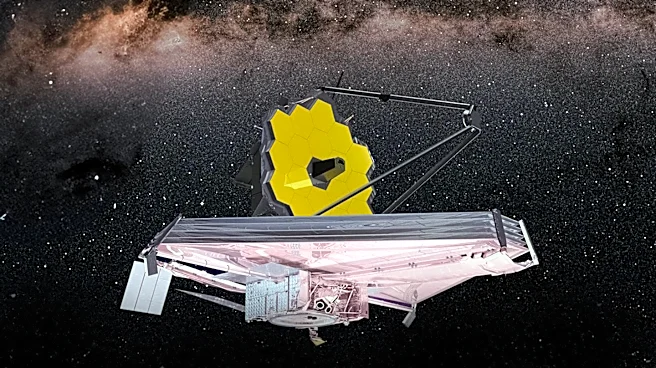
This research is significant because it opens a new avenue for discovering exoplanets, particularly a population that has not yet been observed: those orbiting binary white dwarf systems. Astronomers estimate that the Milky Way contains approximately 10 million such systems, offering a vast potential for new discoveries. The ability to detect these planets through gravitational waves provides a complementary approach to existing methods, which primarily rely on light. This could lead to a more comprehensive understanding of planetary formation and evolution in diverse stellar environments. Furthermore, the proposed method for confirming these detections using the James Webb Space Telescope (JWST) highlights the power of multi-messenger astronomy, combining gravitational wave observations with infrared light data to validate findings and reduce false positives. This collaborative approach enhances the credibility and scientific yield of future exoplanet discoveries.
What's Next?
The next steps involve the continued development and eventual launch of the LISA observatory, which is planned for the mid-2030s. Once LISA becomes operational, scientists will begin collecting gravitational wave data, searching for the characteristic sideband signals indicative of exoplanets in double white dwarf systems. Following initial detections by LISA, the James Webb Space Telescope will play a crucial role in confirming these findings. Researchers will use JWST's infrared sensitivity to look for an infrared excess in these systems, which would further corroborate the presence of a planet. This multi-observatory approach will be essential for establishing the authenticity of these new exoplanet discoveries and for characterizing their properties. Further theoretical work may also refine the detection and confirmation methods as the mission launch approaches.
Beyond the Headlines
The potential discovery of exoplanets around binary white dwarf systems could significantly alter our understanding of planetary habitability and survival. White dwarfs are the remnants of stars like our Sun, and finding planets orbiting them suggests that planets can endure the dramatic evolutionary stages of their host stars, including the red giant phase. This raises profound questions about the resilience of planetary systems and the conditions under which life might persist or arise in such environments. The use of gravitational waves for exoplanet detection also represents a technological leap, pushing the boundaries of observational astronomy and opening up entirely new windows into the universe. It underscores the ongoing shift towards multi-messenger astronomy, where different cosmic signals (light, gravitational waves, neutrinos) are combined to paint a more complete picture of celestial phenomena, potentially revealing aspects of the cosmos that are invisible through traditional means.