





What's Happening?
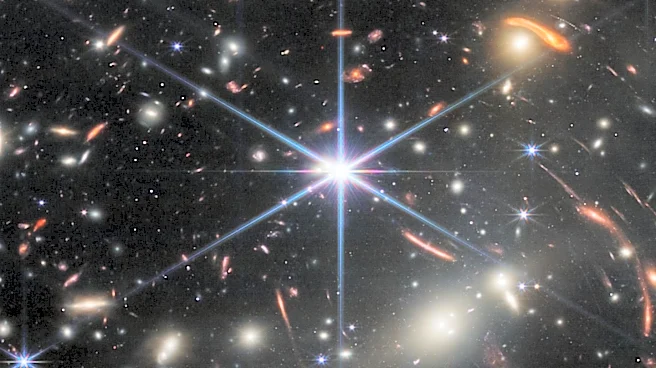
NASA's Hubble and James Webb Space Telescopes have provided detailed images of the galaxy MXDFz4.4, located 12.4 billion light-years away. This galaxy existed 1.4 billion years after the Big Bang, during the end of the Era of Reionization. The images show
that bursts of young stars in MXDFz4.4 cleared the surrounding space, transforming it from opaque to clear. This discovery offers insights into how the universe transitioned from a foggy state to transparency. The study, led by Ilias Goovaerts from the Space Telescope Science Institute, highlights the galaxy's ionizing photons, which played a crucial role in this transformation.
Why It's Important?
The findings from MXDFz4.4 provide critical evidence for understanding the universe's evolution during the Era of Reionization. This period marked a significant transformation in the universe's structure, affecting the formation of galaxies and stars. By studying MXDFz4.4, scientists gain insights into the processes that cleared the cosmic fog, allowing light to travel freely. This research enhances our understanding of cosmic history and the conditions that led to the universe's current state. It also underscores the importance of advanced telescopes like Hubble and Webb in exploring distant cosmic phenomena.