






What's Happening?
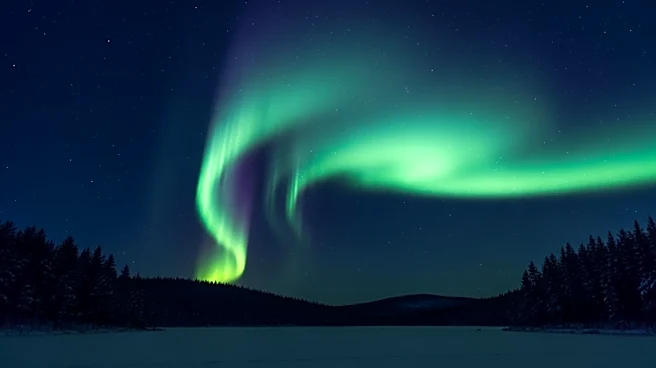
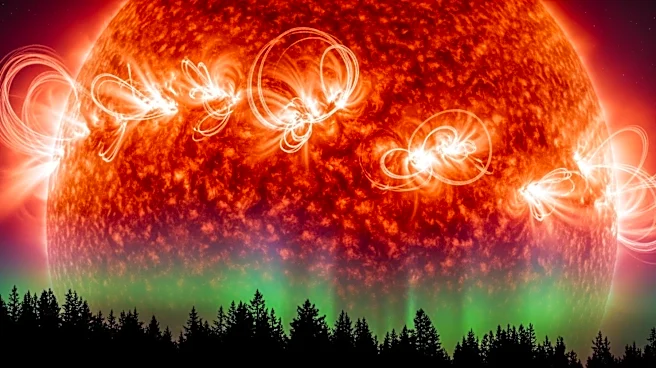
A geomagnetic storm, driven by a fast stream of solar wind from a coronal hole in the sun's atmosphere, is anticipated to create visible auroras across parts of the northern United States. The National Oceanic and Atmospheric Administration's (NOAA) Space
Weather Prediction Center forecasts moderate (G2) geomagnetic storm conditions from the night of May 14 into May 15, with the strongest activity expected between 11 p.m. and 2 a.m. EDT. This phenomenon could make the northern lights visible as far south as New York and Idaho, extending to other states like Michigan, Minnesota, Montana, North Dakota, and Washington. However, the visibility of auroras is contingent on factors such as cloud cover, darkness, and the Earth's magnetic field's response to the solar wind.
Why It's Important?
The occurrence of geomagnetic storms and the resulting auroras are significant for both scientific and public interest. For scientists, these events provide valuable data on solar activity and its interaction with Earth's magnetic field, which can have implications for understanding space weather and its effects on satellite operations and communication systems. For the public, the northern lights offer a rare and spectacular natural display, drawing interest from photographers and skywatchers. The potential visibility of auroras in more southern latitudes than usual could increase public engagement and awareness of space weather phenomena.
What's Next?
As the geomagnetic storm progresses, continued monitoring by NOAA and other space weather agencies will be crucial to provide updates on aurora visibility and potential impacts on technology. Individuals interested in viewing the northern lights are advised to seek dark sky locations away from city lights and to use smartphone cameras to capture faint auroras. Space weather apps can offer real-time forecasts and alerts to enhance the viewing experience. The ongoing solar activity may also prompt further scientific studies into the effects of geomagnetic storms on Earth's environment.