



What's Happening?
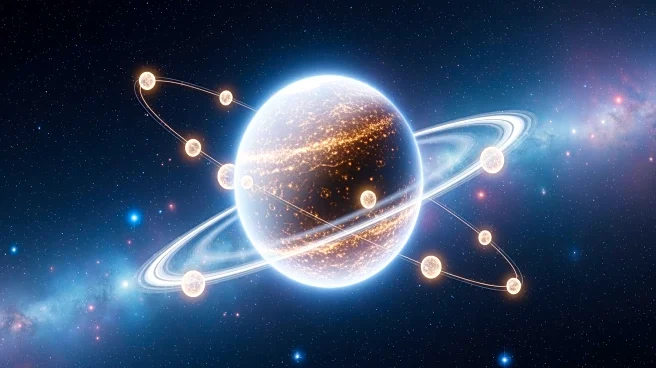
In 2025, astronomers made a significant discovery by identifying more than 100 previously unknown moons within our solar system. This includes 128 new moons orbiting Saturn, increasing its total to 274. The discovery was led by Edward Ashton and his team
at Academia Sinica in Taiwan, utilizing images from the Canada-France-Hawaii Telescope. The process involved stacking hours of images to detect objects too dim to be seen otherwise. Additionally, a new moon was found orbiting Uranus, bringing its total to 29. This discovery is expected to enhance our understanding of planetary formation.
Why It's Important?
The discovery of these moons is crucial for advancing our knowledge of how planets and their satellites form and evolve. By cataloging these celestial bodies, scientists can refine models of planetary formation, offering insights into the processes that lead to the creation of moons. This research could have broader implications for understanding the dynamics of other planetary systems beyond our own. The findings also highlight the potential for further discoveries, particularly around planets like Neptune and Uranus, which may host additional undiscovered moons.
What's Next?
The team responsible for the discovery now has the opportunity to name the new moons, although many may not receive informal names due to their large number. Future research will likely focus on identifying more moons and understanding their characteristics. This ongoing exploration could lead to further breakthroughs in planetary science, potentially revealing new aspects of our solar system's history and evolution.