







What's Happening?
Recent scientific announcements have sparked discussions about the potential discovery of extraterrestrial life. In 2025, researchers reported possible biological activity on the exoplanet K2-18b, based on atmospheric signatures. Similarly, NASA announced
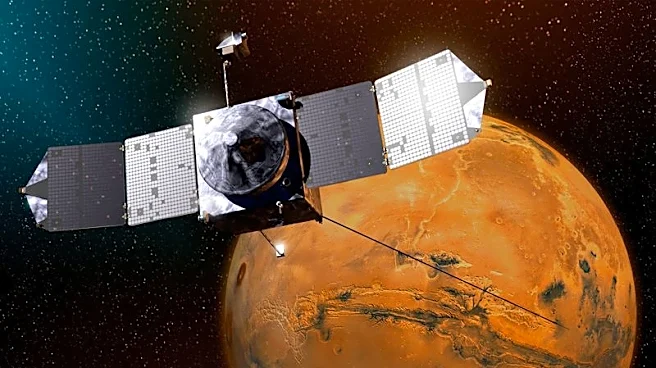
potential biosignatures on Mars from a rock sample named 'Cheyava Falls'. These findings have led to extensive media coverage and public interest. To gauge scientific opinion, a survey was conducted among astrobiologists to understand their views on these claims. The survey revealed cautious optimism, with a small percentage of scientists agreeing that extraterrestrial life had probably been found. The majority remained skeptical or neutral, highlighting the complexity and uncertainty inherent in interpreting such evidence.
Why It's Important?
The potential discovery of extraterrestrial life has significant implications for science and society. It challenges our understanding of life and its existence beyond Earth, potentially reshaping scientific theories and public perceptions. The cautious response from the scientific community underscores the need for rigorous evidence and careful interpretation. This situation highlights the importance of scientific consensus and the role of expert opinion in guiding public discourse. The findings also emphasize the need for continued exploration and research to validate or refute these claims, which could have profound impacts on fields such as astrobiology, planetary science, and beyond.
What's Next?
Further research and exploration are expected to continue in the quest to confirm or disprove the presence of extraterrestrial life. Scientists will likely focus on obtaining more concrete evidence through advanced technology and missions. The scientific community may also engage in more systematic polling to better understand expert opinions and how they evolve over time. Public interest and media coverage are expected to persist, potentially influencing funding and policy decisions related to space exploration and astrobiology.
Beyond the Headlines
The broader implications of these findings extend to other scientific fields, such as climate science and artificial intelligence, where public discussions often rely on perceived scientific consensus. The need for systematic measurement of scientific opinion is crucial in areas with emerging evidence or significant uncertainty. Efforts to better understand how scientific communities respond to uncertainty can enhance public discourse and policy-making, ensuring that decisions are informed by a comprehensive understanding of expert views.