






What's Happening?
Japan's Mogami-class frigates are employing a new strategy for mine countermeasures by deploying 13-foot OZZ-5 drones to detect sea mines, keeping the steel frigates safely out of minefields. This approach was recently demonstrated in a two-week exercise,
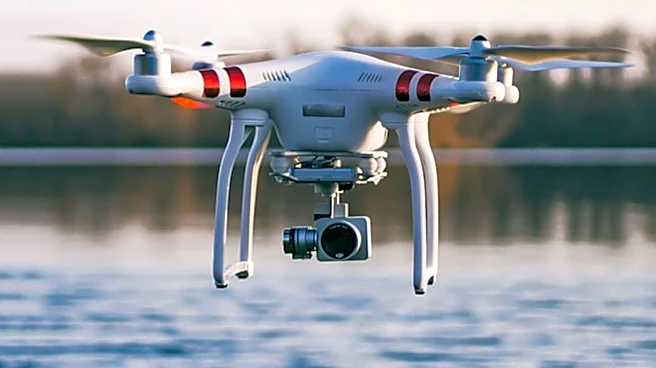
Mine Warfare Exercise 2JA, in Mutsu Bay, where a Mogami-class frigate, the Niyodo, operated alongside a U.S. Navy Avenger-class ship, the USS Chief, which has a wooden hull designed to be less detectable by mines. The OZZ-5 drone, built by Mitsubishi Heavy Industries, is equipped with two synthetic aperture sonars—a Japanese low-frequency set and a French high-frequency set—allowing it to identify mines buried in the seabed and distinguish them from other objects. The drone only hunts for mines, with an unmanned surface boat, the Umikaze, then deployed to dispose of them. This layered drone system represents a significant shift from traditional mine warfare, which has historically relied on specially built wooden or fiberglass-hulled ships to avoid magnetic mine detection.
Why It's Important?
This development is crucial for U.S. naval strategy and global mine warfare. The U.S. Navy currently relies on wooden-hulled minesweepers, a technology that adversaries have had decades to counter. Japan's drone-centric approach offers a template for modernizing mine countermeasures, potentially reducing risks to human personnel and allowing steel warships to operate more safely in contested waters. Sea mines pose a significant and cost-effective threat, capable of closing vital straits and disrupting maritime trade. By adopting a system where drones perform the dangerous detection tasks, navies can maintain operational flexibility and protect high-value assets. The collaboration between the U.S. and Japanese navies in this exercise highlights a potential future direction for allied mine warfare, emphasizing unmanned systems and advanced sonar technology to address a persistent naval challenge. This shift could influence future U.S. defense procurement and strategic planning, particularly in regions with high mine threat potential.
What's Next?
Japan plans to integrate this drone handling capability into 12 more frigates of an upgraded Mogami design, indicating a full commitment to this new mine countermeasures strategy. Australia has also purchased the upgraded Mogami frigates, with deliveries starting in 2029, and is considering adopting Japan's unmanned mine disposal toolbox for its own naval forces. The U.S. Navy will likely continue to evaluate and potentially integrate similar drone technologies into its fleet, especially given the ongoing development of larger drone submarines for deeper and longer missions. Further exercises and technological advancements are expected to refine these unmanned systems, enhancing their accuracy and real-time data processing capabilities. The long-term goal is to make mine warfare safer and more efficient, moving away from human-crewed vessels in high-risk environments. The funding and political decisions for these large-scale defense projects will be critical in determining the pace of adoption and the future landscape of mine countermeasures.
Beyond the Headlines
The shift towards unmanned systems in mine warfare raises broader questions about the future of naval combat and the role of human personnel. While drones enhance safety and efficiency, they also introduce new challenges related to cybersecurity, autonomous decision-making, and the ethical implications of remote warfare. The dual-sonar system of the OZZ-5, combining Japanese and French technology, underscores the growing importance of international collaboration in developing advanced defense capabilities. This technological convergence suggests a future where military hardware is increasingly modular and interoperable across allied nations. Furthermore, the concept of keeping large, expensive warships out of direct harm's way by deploying smaller, expendable drones could redefine naval architecture and operational doctrines. This evolution could lead to a more distributed and resilient naval force, less vulnerable to traditional threats and better equipped to handle the complexities of modern maritime security.