








What's Happening?
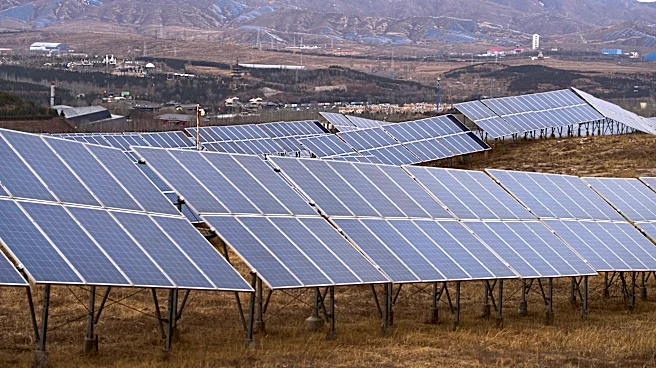
Nigeria has successfully attracted approximately $425 million in investment to establish eight renewable energy manufacturing facilities. This initiative is part of a broader strategy to expand domestic solar panel production and position Nigeria as a clean
energy hub in West Africa. The Managing Director of the Rural Electrification Agency, Abba Aliyu, highlighted that Nigeria's solar manufacturing capacity has more than doubled in recent years, increasing from about 120 megawatts to roughly 300 megawatts, with an additional 3.7 gigawatts in development. This growth is attributed to policy efforts aimed at strengthening local manufacturing capacity and improving investor confidence. The expansion is also leading to export activities, with solar panels produced in Nigeria being shipped to Accra, Ghana.
Why It's Important?
This development is significant as it marks a shift from import dependence towards regional supply, positioning Nigeria as a leader in West Africa's energy transition. The investment and expansion in solar manufacturing are expected to enhance Nigeria's energy infrastructure, reduce reliance on fossil fuels, and contribute to sustainable economic growth. The initiative is also likely to attract further private sector participation and investment, potentially mobilizing an additional $1.1 billion. This could lead to job creation, technological advancements, and increased energy access across the region, benefiting both the economy and the environment.
What's Next?
Nigeria's Distributed Access through Renewable Energy Scale-Up programme, a $750 million initiative, is designed to expand electricity access through mini-grids and decentralized systems. This program operates on a results-based financing model, requiring developers to commit capital before accessing incentives. The initiative is expected to draw attention from other African countries, such as Mozambique, Benin, Burkina Faso, and others, which are exploring similar frameworks. However, challenges such as infrastructure gaps and broader economic uncertainties remain, which will need to be addressed to sustain momentum in the renewable energy sector.