


What's Happening?
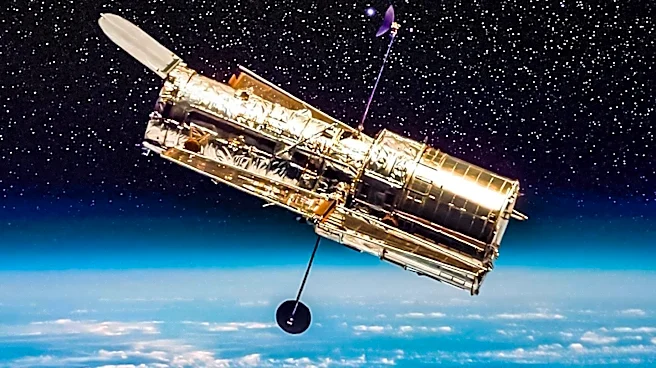
Astronomers, utilizing both NASA's Hubble and James Webb Space Telescopes, have conducted the most sensitive study to date of Trans-Neptunian Objects (TNOs), identifying 27 new icy bodies orbiting beyond Neptune. This coordinated observation, detailed
in two papers in The Astronomical Journal, pushed the direct characterization record to objects as small as 3 miles (5 kilometers) in diameter. A key finding is that these kilometer-scale TNOs, despite billions of years of potential collisions, retain the same surface chemistry as their much larger counterparts. This uniformity challenges a cornerstone assumption in planet formation theory, which predicted that smaller objects would show more signs of collisional alteration. The study also revealed that the size distributions of both 'cold classical' and 'hot' TNO populations are strikingly similar, despite forming under different conditions in the early solar system.
Why It's Important?
This discovery significantly impacts our understanding of how planets form and evolve. The observed uniformity in surface chemistry and size distribution among TNOs suggests that the 'streaming instability' mechanism, a leading theory for planetesimal formation, is more robust and universal than previously thought. This implies that the initial building blocks of rocky planets may form similarly across diverse protoplanetary disk environments, making the raw materials for Earth-like planets potentially common throughout the galaxy. The findings provide crucial observational constraints for refining theoretical models of planet formation, particularly regarding the frequency and effects of collisions in the early solar system. By understanding these fundamental processes, scientists can better predict the prevalence of planetary systems and potentially habitable worlds beyond our own.
What's Next?
Future research will focus on expanding the sample size of characterized TNOs through broader sky surveys using the James Webb Space Telescope. This will provide more statistical power to test the streaming instability models at higher precision and investigate the two main possibilities for the observed color persistence: either collisions are rarer than predicted, or TNO surfaces rapidly regenerate their primordial chemistry. The Vera C. Rubin Observatory in Chile will complement these efforts by conducting wide-area surveys to increase the number of known Kuiper Belt and TNOs, mapping their orbits and dynamical structures. Together, these observational campaigns will provide a comprehensive picture of the outer solar system's assembly and offer deeper insights into the universal processes of planet formation.
Beyond the Headlines
The implications of this research extend beyond our solar system, suggesting that the fundamental processes that built our planets might be common across the cosmos. If the streaming instability reliably produces planetesimals of similar sizes and compositions regardless of local disk parameters, it means the raw materials for rocky planets are not a cosmic accident. This strengthens the scientific foundation for the search for extraterrestrial life, as it implies that the basic ingredients for habitable worlds are likely widespread. The collaborative use of both Hubble and Webb telescopes also highlights the power of combining different observational capabilities to achieve breakthroughs that neither telescope could accomplish alone, pushing the boundaries of astronomical discovery and revealing the intricate history preserved in the most distant and ancient relics of our solar system.