





What's Happening?
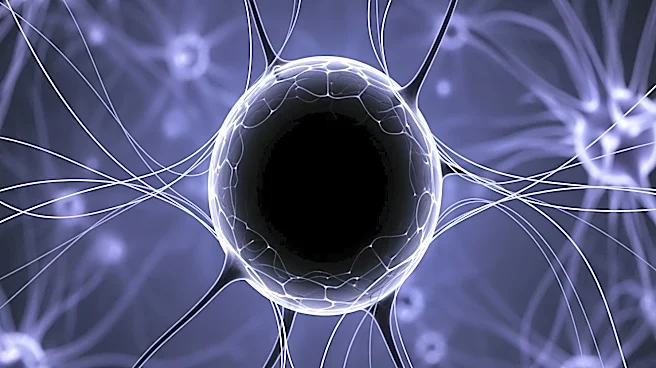
Neuroscientists are investigating a phenomenon in the human brain akin to a 'black hole' in consciousness, where visual information disappears due to a gap in the retina. This gap, known as the blind spot, lacks photoreceptors, yet the brain compensates
by filling in the missing information, creating a seamless visual experience. Researchers from the University of Glasgow and York University are using this phenomenon to test theories of consciousness, such as integrated information theory (IIT) and predictive processing models. These theories explore how the brain constructs reality, with IIT suggesting consciousness is tied to the brain's physical structure, while predictive processing posits that the brain predicts and reconstructs reality.
Why It's Important?
This research has significant implications for understanding consciousness and perception. By examining how the brain fills in gaps in sensory information, scientists can gain insights into the nature of conscious experience and how it is constructed. The findings could challenge existing theories and lead to new models of how the brain processes and interprets sensory data. This understanding is crucial for fields such as cognitive neuroscience and psychology, as it could influence how we approach mental health, artificial intelligence, and human-computer interaction.