





What's Happening?
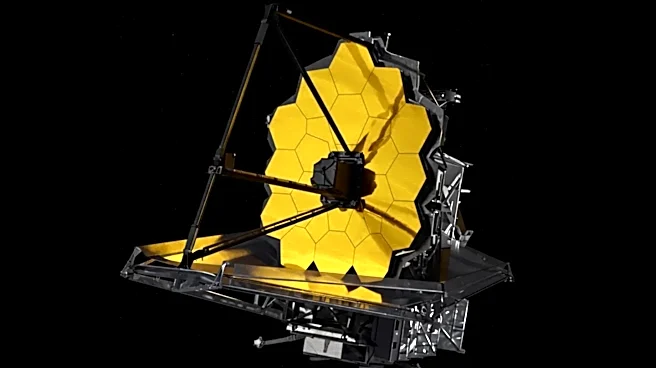
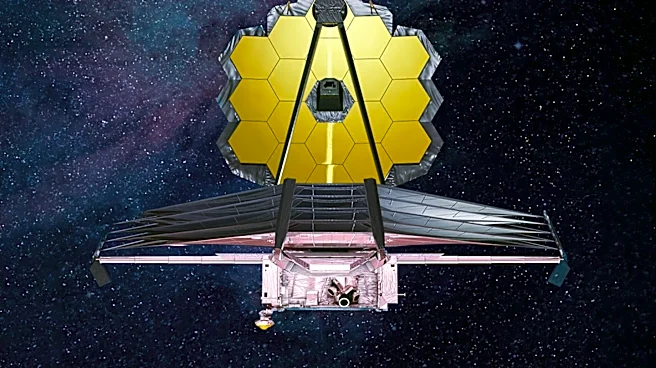
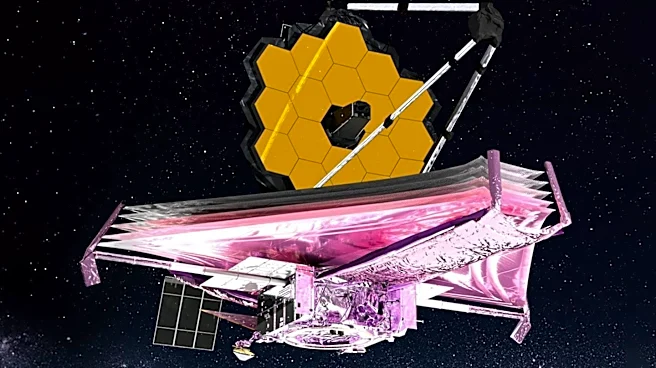
Astronomers using the James Webb Space Telescope (JWST) have discovered a new exoplanet, Beta Pictoris d, orbiting the star Beta Pictoris. This discovery was made possible through the use of the telescope's Near-Infrared Spectrograph (NIRSpec), which
detected the unique chemical fingerprint of the planet's atmosphere. Unlike its counterparts, Beta Pictoris b and c, which were identified through direct imaging, Beta Pictoris d was found by analyzing absorption lines indicative of carbon monoxide in its atmosphere. This method marks a significant advancement in the search for exoplanets, as it allows scientists to identify planets that are obscured by cosmic dust and debris disks. The discovery was further confirmed by follow-up observations using the European Southern Observatory's Very Large Telescope.
Why It's Important?
The discovery of Beta Pictoris d is significant as it demonstrates the potential of spectroscopic techniques in identifying exoplanets that are not visible through traditional imaging methods. This advancement could revolutionize the search for exoplanets, particularly those hidden within bright debris disks. The ability to detect planets through their atmospheric signatures opens new avenues for understanding planetary formation and the conditions that might support life. This finding also highlights the capabilities of the James Webb Space Telescope in contributing to our knowledge of the universe, beyond its renowned imaging capabilities.
What's Next?
Following the discovery of Beta Pictoris d, astronomers are likely to employ similar spectroscopic techniques to explore other star systems with debris disks. This could lead to the identification of more hidden exoplanets, expanding our understanding of planetary systems. Additionally, the data gathered from Beta Pictoris d will be analyzed to learn more about its atmospheric composition and potential for hosting life. The success of this discovery may also prompt further investments in spectroscopic technology and collaborative efforts between international observatories.