


What's Happening?
The Trump administration has formally requested the U.S. Supreme Court to overturn a lower court decision that led to the release of a Georgetown University scholar. The scholar, an Indian citizen named Badar Khan Suri, was arrested by immigration authorities
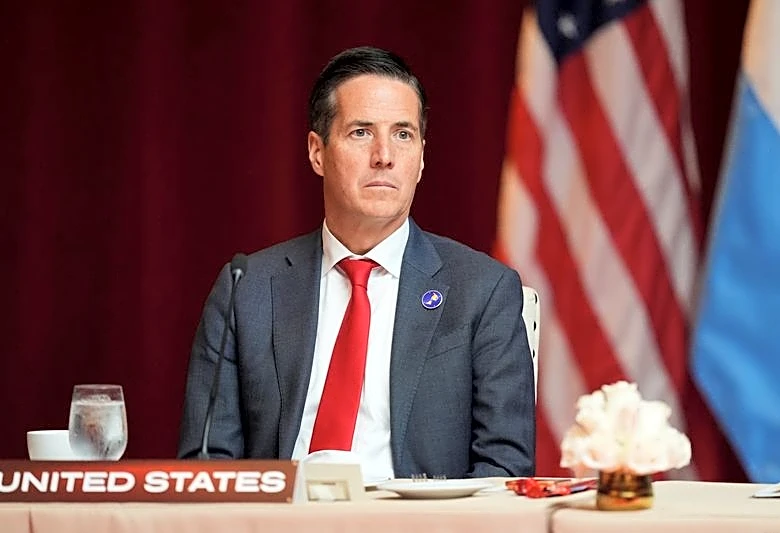
in March 2025 as part of the administration's efforts to detain and deport foreign nationals involved in pro-Palestinian activism on college campuses. Suri was subsequently freed in May 2025 by a district court judge, who determined that Suri was likely to prove his arrest was in retaliation for his constitutionally protected speech. A 2-1 panel of the 4th U.S. Circuit Court of Appeals in July upheld this ruling, stating that a judge could hear challenges to allegedly unconstitutional detentions, even if related to ongoing deportation proceedings. Solicitor General D. John Sauer, in Monday's petition, argued that the 4th Circuit's decision was erroneous and could severely disrupt immigration enforcement nationwide by allowing detainees to challenge deportations outside of established immigration court processes.
Why It's Important?
This case carries significant implications for the balance between national immigration enforcement powers and individual constitutional rights, particularly freedom of speech and due process. The Trump administration's argument that the 4th Circuit's ruling is 'practically disastrous' highlights concerns that it could create a precedent allowing numerous detainees to bypass immigration courts, potentially complicating and delaying deportation proceedings. Conversely, the lower court's decision underscores the importance of judicial oversight to prevent potential abuses of power, ensuring that immigration arrests are not used to suppress constitutionally protected speech. The Supreme Court's involvement will determine the extent to which federal courts can intervene in immigration detention cases, especially when claims of retaliatory arrest for protected speech are raised. The outcome could either strengthen the executive branch's authority in immigration matters or reinforce judicial checks on that power, impacting how future immigration enforcement actions are conducted and challenged.
What's Next?
The U.S. Supreme Court will now decide whether to hear the Trump administration's appeal. If the Supreme Court agrees to take the case, it will review the 4th Circuit's ruling, which allowed a federal judge to order the release of the Georgetown University scholar. A decision by the Supreme Court could either affirm the lower court's stance, thereby establishing a precedent for federal judges to intervene in immigration detention cases based on constitutional claims, or it could side with the Trump administration, reinforcing the executive branch's authority in immigration enforcement and limiting judicial oversight in such matters. The scholar, Badar Khan Suri, remains free, but his long-term status and the broader implications for other individuals in similar situations hinge on the Supreme Court's ultimate decision. The case will likely draw attention from civil liberties advocates, immigration lawyers, and government agencies, all keenly watching for a definitive ruling on the scope of judicial review in immigration detention.
Beyond the Headlines
This legal battle extends beyond the immediate case of the Georgetown scholar, touching upon fundamental questions regarding the rights of non-citizens within the U.S. legal system and the boundaries of executive power. The Trump administration's stance suggests a prioritization of streamlined immigration enforcement, potentially at the expense of individual liberties, particularly when those individuals engage in activism that is perceived as critical of government policy. The case also highlights the increasing tension between national security concerns and free speech, especially in the context of foreign policy debates. A Supreme Court ruling in favor of the administration could embolden future administrations to take more aggressive stances against activists, while a ruling upholding the lower court's decision could reinforce the judiciary's role as a protector of constitutional rights for all individuals within U.S. jurisdiction, regardless of citizenship status. This case could set a significant precedent for how dissent and activism are treated under immigration law.