








What's Happening?
Ethan Arnault, an assistant professor in the College of Engineering and Computer Science at Syracuse University, has been granted an award from the National Science Foundation (NSF). This funding, provided by the NSF's Electrical, Communications and Computing
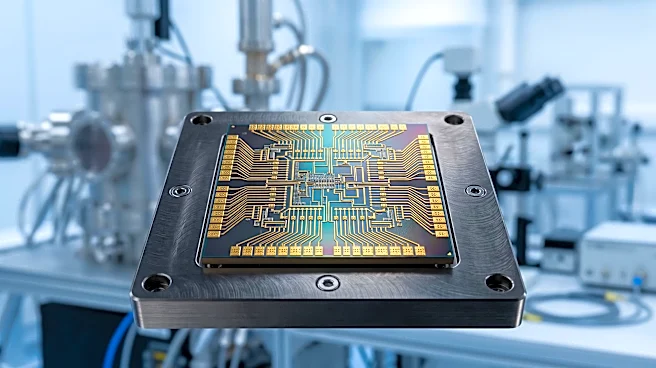
Systems division, is designated for research into developing small devices integrated directly onto computer chips. The primary goal of this research is to address a significant challenge in quantum computing: preventing overheating as quantum processors scale up. Superconducting quantum computers, while promising for complex problem-solving in areas like material design and drug discovery, face limitations due to the heat introduced by microwave cables required to control and read data from qubits. Arnault's work focuses on designing a new type of compact device based on multi-terminal Josephson circuits, which leverage unusual properties of superconducting materials to act as sensitive detectors and low-noise microwave signal sources. This 'cold control' approach aims to place control and measurement electronics directly on the same chip as the qubits, thereby mitigating heat buildup.
Why It's Important?
The development of more efficient and scalable quantum computers has profound implications for U.S. industries, national security, and scientific research. Current quantum computing prototypes are hindered by the need for extremely cold environments, and the heat generated by control cables limits their size and power. Arnault's research offers a potential solution to this fundamental engineering challenge, which could accelerate the development of larger and more practical superconducting quantum computers. By enabling 'cold control' and integrating electronics directly onto the quantum chip, this innovation could remove a major roadblock to achieving fault-tolerant quantum systems. This advancement would help maintain the United States' leadership in quantum information science, fostering breakthroughs in fields ranging from advanced materials to secure communications and drug discovery. The technology could also find applications in other supercooled systems, serving as highly sensitive sensors and amplifiers.
What's Next?
The project is structured into two main parts. The first involves building and refining Josephson parametric amplifier bolometers, which combine a sensor with a signal booster. Researchers will use electrical current and voltage controls on a graphene-based component to detect single microwave photons in the 4 to 8 gigahertz range, commonly used by qubits, with near-instantaneous reset times. The second part will investigate coordinated microwave signals produced by electron groups to determine if they can generate clean, low-noise signals. The long-term objective is to integrate both devices to enable entirely on-chip power measurement, eliminating the need for external equipment. Beyond the technical work, the NSF award will also support the training of future scientists in this field, funding a graduate student and a postdoctoral researcher, providing research experience for undergraduate and high school students, and contributing data for new quantum engineering courses at Syracuse University.
Beyond the Headlines
The pursuit of practical quantum computing involves overcoming not just technical hurdles but also fostering a new generation of skilled researchers. The 'cold control' approach, if successful, represents a paradigm shift in quantum computer architecture, moving away from bulky external components towards integrated, on-chip solutions. This could lead to more robust and compact quantum systems, making them more accessible for research and commercial applications. The ethical implications of powerful quantum computers, particularly in areas like cryptography and national security, are also significant. As these technologies advance, discussions around responsible development and deployment will become increasingly critical. The project's emphasis on training new talent underscores the long-term commitment required to realize the full potential of quantum computing and address its complex societal implications.