
What's Happening?
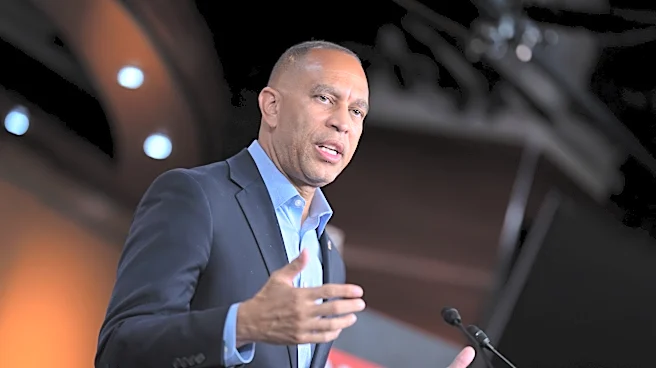
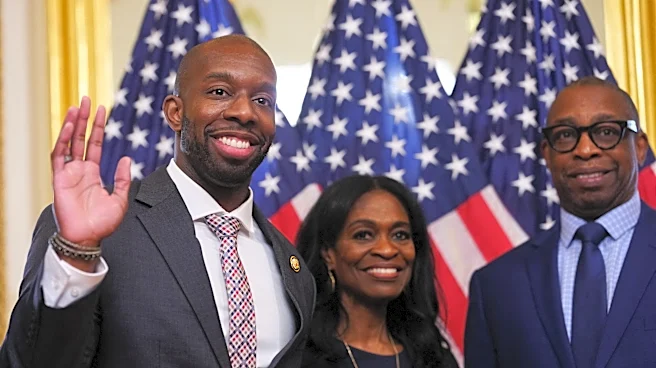
Representative Shontel Brown of Ohio has strongly condemned Palestinian journalist Rula Jebreal's remarks referring to House Minority Leader Hakeem Jeffries as an 'AIPAC monkey' and an 'errand boy.' According
to Israel Hayom, Jebreal made these comments during a podcast discussion on US-Israel relations. While Jebreal attempted to clarify that she did not intend the term 'monkey' in a racist way, suggesting she was referring to the 'see no evil, hear no evil, speak no evil' monkeys, her explanation was widely rejected. The Congressional Black Caucus issued a statement asserting that there is no non-racist way to use such language towards a Black man. Rep. Ritchie Torres of New York also labeled the comments as unequivocally racist. Jebreal later apologized for the 'inappropriate and offensive' term but did not retract her criticism of Jeffries' stance on Israel.
Why It's Important?
This incident highlights the ongoing tensions and sensitivities surrounding race and political discourse in the United States, particularly when intertwined with foreign policy debates. The swift and unified condemnation from members of Congress, including Rep. Brown, underscores a zero-tolerance stance against racist language in political commentary. The controversy also brings attention to the scrutiny faced by public figures who make remarks that can be interpreted as racially charged, regardless of stated intent. For the Democratic Party, the incident reinforces the need for internal cohesion against divisive rhetoric, especially concerning prominent Black leaders like Hakeem Jeffries. The rejection of Jebreal's explanation by the Congressional Black Caucus signals a firm boundary against attempts to rationalize or minimize the impact of such slurs, emphasizing the historical weight of terms like 'monkey' when directed at Black individuals.
What's Next?
The immediate aftermath will likely involve continued scrutiny of Rula Jebreal's public statements and potential repercussions for her media engagements. While Jebreal has apologized for the specific term, her underlying criticism of Leader Jeffries' relationship with AIPAC remains, suggesting that the broader debate on US-Israel policy and its intersection with domestic politics will persist. Political figures and media outlets may face increased pressure to vet commentators and ensure that discussions remain respectful and free of racist undertones. The incident could also prompt further discussions within political circles about the language used in criticizing political opponents, particularly when race is a factor. Leader Jeffries himself has not yet responded to the remarks, and any future statement from him could further shape the narrative.
Beyond the Headlines
This event delves into deeper issues concerning the weaponization of language and the impact of historical racial tropes in contemporary political discourse. The use of 'monkey' to describe a Black individual carries a deeply painful and dehumanizing history, making any attempt to recontextualize it problematic. The incident also touches upon the complexities of free speech versus hate speech, and the responsibility of commentators to understand the historical and social implications of their words. Furthermore, it highlights the challenges faced by public figures in navigating highly charged geopolitical topics, where criticism can sometimes devolve into offensive rhetoric. The strong reaction from Black congressional leaders reinforces the ongoing fight against systemic racism and the vigilance required to combat its manifestations, even in seemingly nuanced contexts.