
What's Happening?
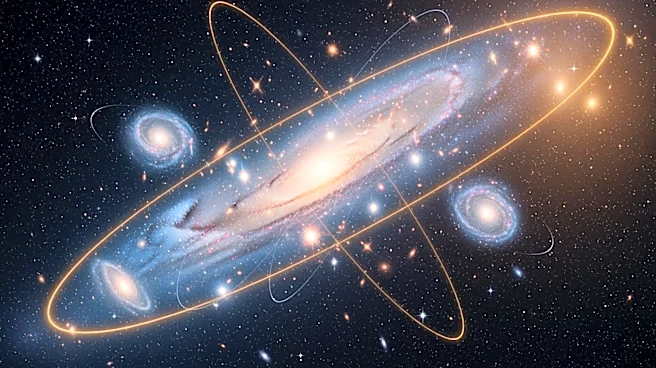
A team of American scientists has discovered a galaxy, XMM-VID1-2075, that shows virtually no rotation, challenging existing theories about galaxy formation and rotation. Observed using the James Webb
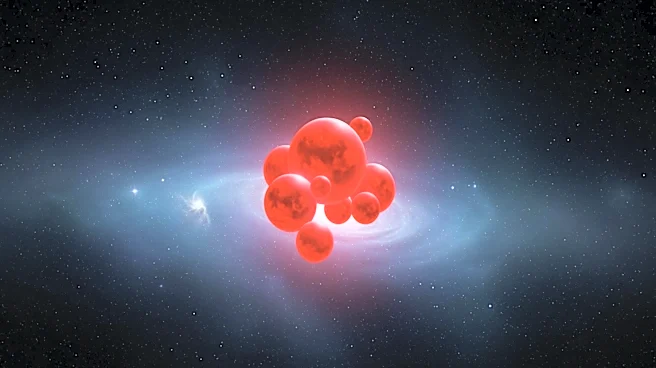
Space Telescope, this galaxy is located in the early universe, appearing as it was when the universe was only 2 billion years old. The lack of rotation in such a massive galaxy is unexpected, as rotation is a fundamental property of galaxies. The scientists propose that this phenomenon may result from the merger of two galaxies that were rotating in opposite directions at nearly identical speeds.
Why It's Important?
The discovery of a non-rotating galaxy in the early universe has significant implications for our understanding of galaxy formation and evolution. It challenges the conventional view that rotation is a universal characteristic of galaxies, prompting scientists to reconsider existing models. This finding could lead to new insights into the processes that govern galaxy dynamics and the role of mergers in shaping their properties. The research also highlights the capabilities of the James Webb Space Telescope in advancing our knowledge of the universe.