

What's Happening?
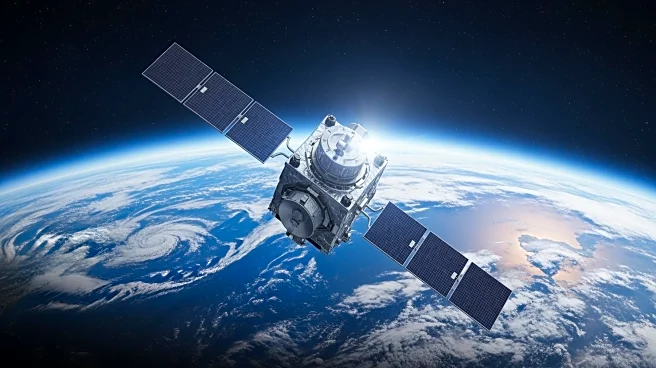
Researchers using NASA's Fermi Gamma-ray Space Telescope may have observed dark matter for the first time. The study, led by Tomonori Totani from the University of Tokyo, suggests that gamma-ray emissions detected by the telescope could be the result
of weakly interacting massive particles (WIMPs) colliding and annihilating each other. This discovery, if confirmed, would provide significant evidence for the existence of dark matter, which is believed to make up about 27% of the universe's mass. The findings are based on the theoretical prediction that such collisions would produce gamma rays, a hypothesis that has been a focus of dark matter research for decades.
Why It's Important?
The potential observation of dark matter is a groundbreaking development in astrophysics, as it could confirm the existence of a substance that has eluded direct detection for nearly a century. Dark matter is thought to play a crucial role in the formation and structure of the universe, influencing the behavior of galaxies and cosmic phenomena. Confirming its existence would not only validate long-standing theories but also open new avenues for understanding the fundamental composition of the universe. This discovery could have profound implications for particle physics and cosmology, potentially leading to new theories and models that explain the universe's behavior.
What's Next?
The next steps involve independent verification of Totani's findings by other researchers. This includes examining gamma-ray emissions from other cosmic sources, such as dwarf galaxies, to rule out alternative explanations for the observed data. If these findings are corroborated, it could lead to a paradigm shift in our understanding of the universe. Further research will likely focus on refining the detection methods and exploring the implications of dark matter's existence on current cosmological models.