





What's Happening?
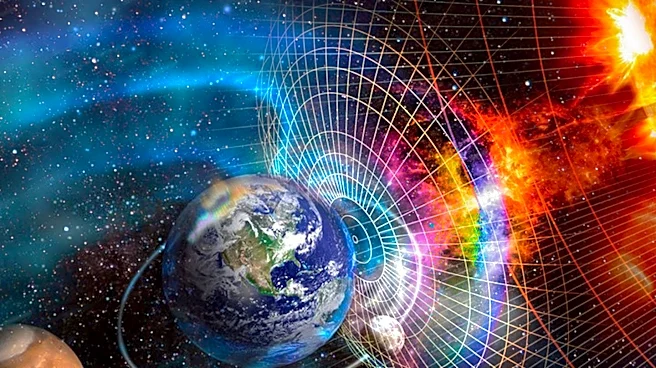
Space weather, driven by solar activity, creates auroras and can induce electric currents that pose a threat to power grids and other technological systems on Earth. Researchers are working to understand how these events, particularly substorms, affect
infrastructure. A substorm involves an explosive release of magnetic energy tens of thousands of miles from Earth, which can impact the ground within minutes. This process begins when a coronal mass ejection from the sun interacts with Earth's magnetosphere, stretching magnetic field lines into a 'magnetotail.' When these lines reconnect, stored energy is released, sending energetic particles toward Earth. These particles collide with atmospheric atoms, producing auroras and driving strong electrical currents in the upper atmosphere. Rapid changes in these currents can cause Earth's magnetic field at ground level to shift sharply, inducing currents in power lines and potentially damaging transformers or tripping circuit breakers. Observations from NASA spacecraft and ground-based magnetometers have shown that these effects can reach Earth's surface within minutes of the energy release.
Why It's Important?
The connection between auroras and ground-level electrical disturbances highlights a significant vulnerability for U.S. infrastructure. While auroras are visually spectacular, they are a visible manifestation of space weather events that can have severe consequences for power grids. Historical events, such as the 1989 geomagnetic storm that caused a nine-hour blackout for over 6 million people in Hydro-Québec, and the 2003 Halloween storms that led to a blackout in Malmö, Sweden, demonstrate the real risk. More recently, the May 2024 geomagnetic storm stressed power grids in southern Sweden, forcing a transmission link to disconnect. Understanding the rapid progression of these events, from magnetotail energy release to ground impact within minutes, is crucial for developing effective mitigation strategies. Power grid operators need precise, real-time information to prepare for and respond to potential disruptions, protecting critical services and economic stability.
What's Next?
Ongoing research aims to refine the understanding of how substorms and other space weather events impact Earth's surface. Scientists are investigating the variability of these impacts, noting that geomagnetic stations tens to hundreds of miles apart can record vastly different responses depending on local conditions like atmospheric and ground conductivity. Improved space weather forecasts are essential to provide power grid operators with more lead time to monitor grid conditions and prepare for disruptions. While solar activity can be forecast hours in advance, the effects of substorms develop on timescales of minutes, necessitating rapid response protocols. Future efforts will likely focus on integrating real-time data from spacecraft and ground sensors to create more accurate predictive models, allowing for quicker alerts and more targeted protective measures for critical infrastructure.
Beyond the Headlines
The dual nature of space weather—creating beautiful auroras while posing a threat to modern technological society—underscores a complex interplay between natural phenomena and human infrastructure. The increasing reliance on interconnected power grids and sensitive electronic systems means that the risks from space weather are growing. Beyond immediate blackouts, prolonged disruptions could have cascading effects on communication systems, financial markets, and essential services. This situation highlights the need for robust international collaboration in space weather monitoring and research, as these phenomena are global in scope. Furthermore, it prompts discussions about grid resilience, the development of hardened infrastructure, and the implementation of advanced warning systems to safeguard against events that originate millions of miles away but can directly impact daily life on Earth. The invisible currents flowing beneath our feet, driven by distant solar activity, represent a persistent and evolving challenge for technological societies.