
What's Happening?
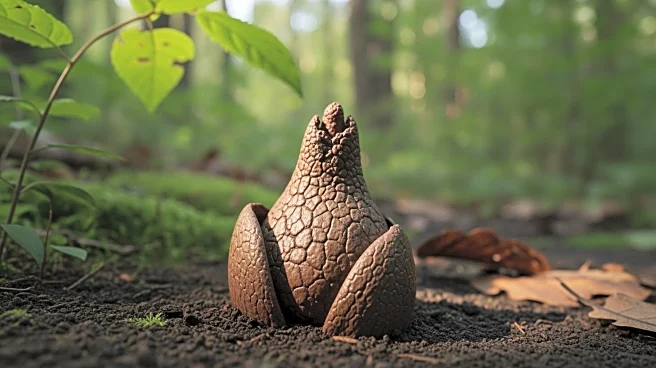
Balanophora, a plant often mistaken for a mushroom, is one of the most unusual plants on Earth. Found in the forests of Taiwan, Japan, and Okinawa, it lacks chlorophyll and survives as a parasite by attaching
to tree roots. Recent research by the Okinawa Institute of Science and Technology and other institutions has uncovered its unique evolutionary traits. Balanophora retains plastids, essential for its parasitic lifestyle, despite losing many genes. The plant's ability to reproduce without fertilization in some species adds to its intrigue, highlighting its adaptability and evolutionary significance.
Why It's Important?
The study of Balanophora offers insights into plant evolution and adaptation. Its parasitic nature and ability to reproduce without fertilization challenge traditional plant biology concepts. Understanding Balanophora's survival mechanisms could inform conservation efforts, as its specific habitat requirements make it vulnerable to environmental changes. The research also contributes to broader ecological knowledge, emphasizing the importance of preserving biodiversity and studying rare species to uncover evolutionary processes.
Beyond the Headlines
Balanophora's unique characteristics raise questions about the evolutionary paths of parasitic plants. Its reliance on specific tree species for survival highlights the delicate balance within ecosystems. The plant's rarity and vulnerability to habitat destruction underscore the need for conservation efforts. Studying Balanophora may also provide insights into the evolution of other parasitic organisms, offering a broader understanding of life's adaptability and resilience.