

What's Happening?
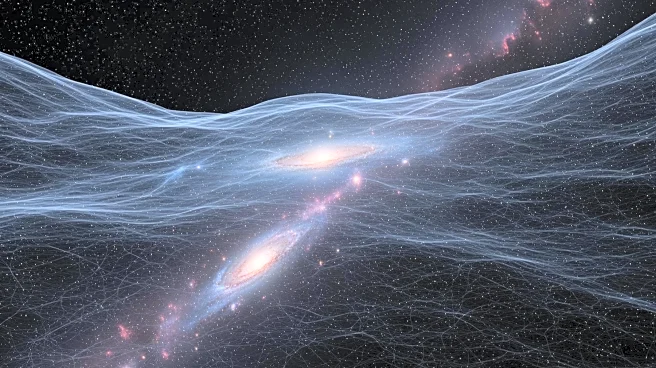
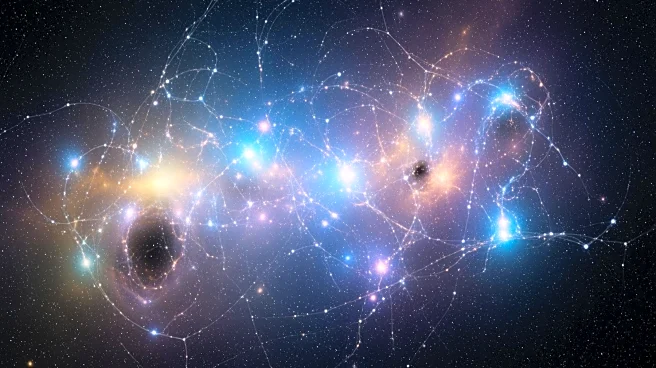
Astronomers have developed one of the most comprehensive cosmic maps to date, revealing a 'sea of light' that filled the early universe. This 3D map, created using data from the Hobby-Eberly Telescope Dark Energy Experiment (HETDEX), focuses on light emitted
by hydrogen, the universe's simplest and most abundant element. The map provides a glimpse into the universe as it appeared 9 to 11 billion years ago, during a period of intense star formation. The technique used, known as line-intensity mapping, allows researchers to chart the distribution of hydrogen and other elements, offering insights into the structure of luminous galaxies and gas clouds. This research, published in The Astrophysical Journal, aims to enhance understanding of dark energy and gravity's role in shaping the universe.
Why It's Important?
The creation of this detailed cosmic map is significant for several reasons. It provides a new method for studying the universe's large-scale structure and the forces that govern it, such as dark energy and gravity. By understanding how galaxies cluster and the distribution of mass, scientists can gain insights into the properties of gravity and the universe's expansion. This research also contributes to the broader field of cosmology by offering a new way to examine the universe's evolution and the role of dark energy. The findings could lead to a better understanding of the universe's history and its future trajectory.
What's Next?
Future research will focus on refining noise-reduction techniques to better isolate the signals from ancient galaxies. This will involve improving methods to separate desired signals from various astronomical and terrestrial contaminants. Researchers plan to use fainter sources and lower-mass objects as tracers of cosmic evolution, which could provide more robust constraints on gravity models. The ongoing development of new instruments and techniques promises to usher in a 'golden age' of cosmic mapping, offering deeper insights into the universe's structure and the forces that shape it.