
What's Happening?
A collaborative study by researchers from the UK, USA, and Japan has explored the evolutionary trade-offs in ant societies, focusing on the balance between individual protection and colony size. The study found
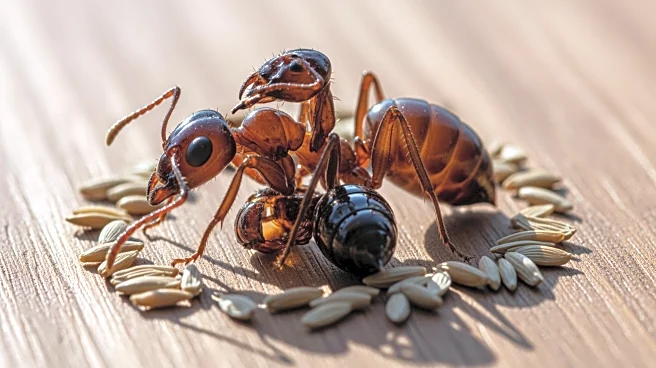
that as ant colonies grew in complexity and numbers, they evolved to produce workers that are smaller and less armored. This adaptation allows colonies to maintain large workforces without the high resource costs associated with robust exoskeletons. The research utilized advanced 3D scanning technology to analyze the exoskeletons of over 500 ant species, revealing that colonies with massive workforces tend to invest less in individual worker defenses.
Why It's Important?
This research provides insights into the evolutionary strategies that have enabled ants to become one of the most successful groups of organisms on Earth. Understanding these trade-offs is crucial for comprehending how social insects optimize resource allocation to thrive in diverse environments. The findings have broader implications for studying other social organisms and their evolutionary adaptations. By prioritizing colony size over individual protection, ants demonstrate a unique approach to survival that could inform studies on resource management and social organization in other species.
What's Next?
The study opens avenues for further research into the evolutionary biology of social insects. Future studies could explore how these trade-offs impact ant behavior and ecology in different environments. Additionally, researchers may investigate the genetic and environmental factors that drive these evolutionary changes, providing a deeper understanding of the mechanisms behind social insect success.
Beyond the Headlines
The study highlights the importance of considering both individual and collective strategies in evolutionary biology. It challenges traditional views on the necessity of individual robustness for survival, suggesting that in some cases, collective strength can outweigh individual weaknesses. This perspective could influence future research on social structures and resource allocation in both natural and artificial systems.