






What's Happening?
A team led by the Planetary Science Institute (PSI) has been selected by NASA for its Payloads and Research Investigations on the Surface of the Moon (PRISM) program. The project, named Geophysical Instruments for Marius Lunar pit Investigation (GIMLI),
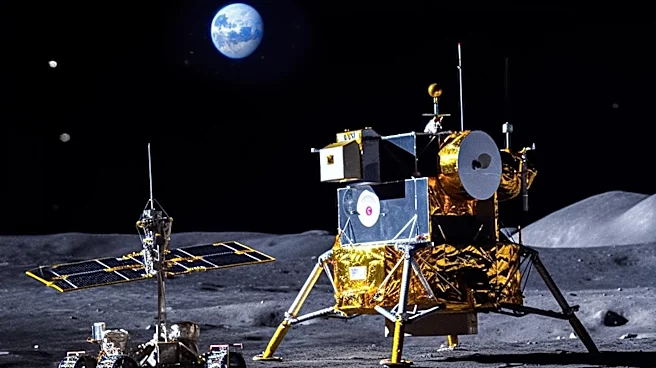
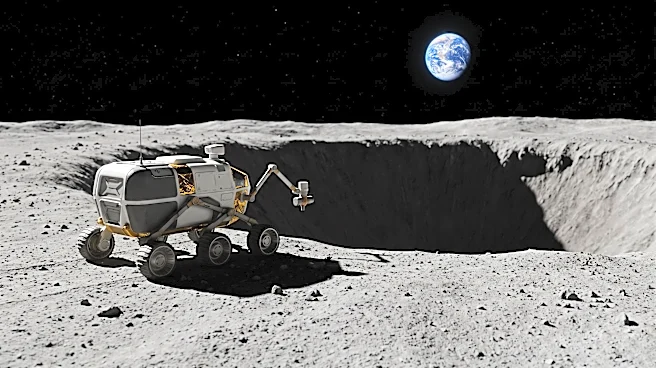
aims to investigate a potentially large underground cave extending from a lunar pit. PSI is partnering with Honeybee Robotics, which will build much of the equipment and instrumentation. The mission will utilize a Commercial Lunar Payloads Services (CLPS) initiative provided lander and rover to carry instruments such as ground-penetrating radar, seismic sensors, and a gravimeter to the Marius Hill Pit (MHP). The goal is to determine if a cave or lava tube exists and, if so, its size, and to study the geology and volcanic history of the region.
Why It's Important?
This NASA PRISM program selection is crucial for advancing lunar exploration and understanding the Moon's geological history. The potential discovery of large underground caves or lava tubes could have significant implications for future human spaceflight, as these structures might offer natural shelters for astronauts from radiation and extreme temperature fluctuations on the lunar surface. This could reduce the engineering challenges and costs associated with building habitats. The GIMLI project's use of advanced geophysical instruments represents a significant step in lunar science, providing direct subsurface measurements that have not been extensively performed since the Apollo missions. The collaboration between PSI, Honeybee Robotics, and international partners like the Norwegian Space Agency also highlights the growing trend of public-private partnerships and international cooperation in space exploration, which can accelerate scientific discovery and technological development.
What's Next?
The PSI-led team, in partnership with Honeybee Robotics and other collaborators, will proceed with the development and integration of the GIMLI instruments onto a CLPS lander and rover. Honeybee Robotics will manage the project and build key instrumentation, while the Norwegian Space Agency will provide the ground-penetrating radar. Once deployed on the lunar surface, the instruments will conduct direct investigations of the Marius Hill Pit. The data collected will be analyzed to confirm the presence and characteristics of any subsurface voids, as well as to study the volcanic processes that shaped the Moon. Even if no cave is found, the data will provide valuable insights into the pit's formation and the region's geology, contributing to a better understanding of lunar evolution and informing future mission planning.
Beyond the Headlines
The exploration of lunar caves holds profound implications beyond immediate scientific discovery. Such caves could potentially harbor resources like water ice, protected from solar radiation, which would be vital for sustaining long-duration human missions and establishing permanent lunar bases. They could also preserve unique geological and astrobiological records, offering clues about the Moon's past and the early solar system. The GIMLI mission's innovative approach to subsurface exploration could set a precedent for future planetary missions, demonstrating the effectiveness of combining various geophysical techniques. This endeavor aligns with NASA's broader Artemis program goals of returning humans to the Moon and preparing for missions to Mars, making the search for natural shelters a critical component of humanity's expansion into space.