
What's Happening?
Researchers have uncovered evidence suggesting that an enormous ancient cliff system, a 'great escarpment,' may have played a significant role in exposing the deep rocks of the Grand Canyon nearly a billion
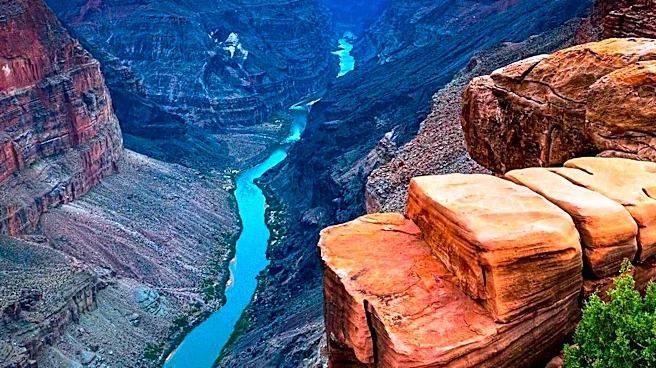
years before the Colorado River began carving the modern landscape. This study, led by scientists at the University of Southampton, proposes that this vast escarpment formed approximately 800 million years ago during the breakup of the supercontinent Rodinia. These towering cliffs, potentially reaching a kilometer in height and extending for thousands of kilometers across western North America, underwent extensive erosion. This erosion removed vast amounts of material, ultimately exposing the ancient crystalline basement rocks now visible in the Grand Canyon in southern Arizona. The findings also offer insights into the formation of the Great Unconformity, a mysterious gap in the geological record spanning over a billion years.
Why It's Important?
This discovery fundamentally reinterprets the geological history of one of North America's most iconic landmarks, the Grand Canyon. By identifying a previously unrecognized mega-cliff system, scientists can better explain the 'missing billion years' in the Grand Canyon's rock record, a long-standing geological enigma. The ancient escarpment's influence extended beyond the Grand Canyon, shaping river paths, sediment collection, and sea level changes across the continent before the Cambrian explosion. This research provides a new framework for understanding how continental rifting and erosion can dramatically alter landscapes over hundreds of millions of years. It also highlights the dynamic nature of Earth's crust and the profound impact of supercontinent cycles on geological formations, offering a comparative lens to modern escarpments in Africa, Brazil, India, and Antarctica.
What's Next?
The research team plans to continue investigating the implications of this ancient mega-cliff system. Future work will likely involve more detailed geological mapping and analysis across the proposed extent of the escarpment, which includes areas in Arizona, Utah, Idaho, Wyoming, Colorado, Texas, Oklahoma, Arkansas, Missouri, and Illinois. Scientists will aim to identify further evidence of the escarpment's presence and its specific impact on regional geology. This could involve applying similar plate tectonic reconstructions and landscape evolution models to other ancient continental interiors with significant gaps in their geological records. The findings may also prompt a re-evaluation of existing geological models for North America and other continents, leading to a more comprehensive understanding of Earth's long-term geological evolution.
Beyond the Headlines
This discovery has broader implications for how geologists approach the study of ancient landscapes and the interpretation of geological records. The concept of a 'lost' mega-cliff system underscores the vastness of geological time and the transformative power of erosion, which can erase billions of years of history. It challenges the assumption that current geological features are solely the product of more recent processes, emphasizing the deep-time influences that shape our planet. The research also highlights the interconnectedness of geological processes, where events like supercontinent breakup can trigger a cascade of effects, from mountain formation and erosion to the distribution of sediments and the evolution of life. This deeper understanding of Earth's past can inform our comprehension of ongoing geological changes and the long-term evolution of planetary surfaces.