






What's Happening?
Colorado is actively promoting coexistence policies for beavers, recognizing their significant ecological benefits, particularly in urban and arid regions. Vikki Vargas-Madrid, wildlife program manager for Denver Parks and Recreation, highlights that
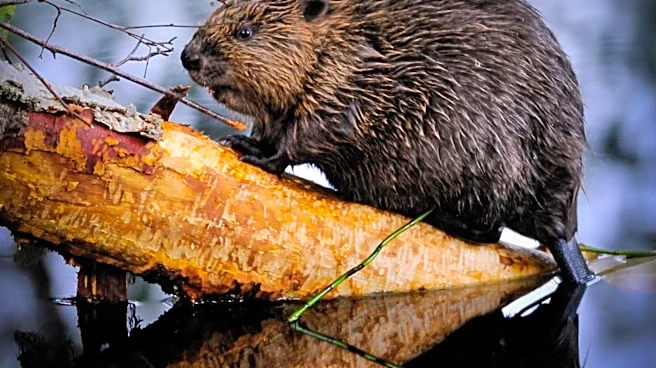
beavers create wetlands that support diverse aquatic vegetation and wildlife. Kris Inman, the new beaver conservation program manager for Colorado Parks and Wildlife (CPW), is implementing the state's new Beaver Conservation and Management Strategy, released in March. This strategy aims to leverage beavers' natural engineering abilities to manage water resources, especially in drought-prone areas, and aid in wildfire prevention. Beavers' dam-building activities reconnect surface water with groundwater, allowing the ground to retain winter snowpack longer and slowly release it into streams, providing crucial water supplies. The city of Denver recently approved $20.6 million for improvements along Sanderson Gulch, which will deepen the creek and create more ecological benefits, with the expectation that beavers will eventually return to the enhanced habitat.
Why It's Important?
The shift in Colorado's approach to beaver management is important for several reasons. Historically, beavers were often eradicated as nuisances, but their role as a keystone species is now being recognized for its environmental and economic value. Their ability to create wetlands and regulate water flow is critical for ecosystem health, supporting biodiversity and providing natural water storage in a state frequently affected by drought. Furthermore, beaver activity can create natural fuel breaks, offering a cost-effective and sustainable method for wildfire prevention, a growing concern in the Western U.S. This strategy represents a move towards nature-based solutions for environmental challenges, potentially reducing reliance on more expensive and less sustainable human-engineered interventions. The success of these coexistence policies could serve as a model for other states facing similar environmental pressures, demonstrating how integrating wildlife management with ecological restoration can yield significant benefits for both nature and human communities.
What's Next?
Colorado Parks and Wildlife will continue to implement its Beaver Conservation and Management Strategy, focusing on promoting coexistence practices across the state. This includes educating the public on the benefits of beavers, installing flow devices to mitigate conflicts with landowners, and potentially using 'beaver dam analogs' to encourage beaver activity in strategic locations for water management and wildfire prevention. Local initiatives, such as Denver's Sanderson Gulch project, will proceed with creek improvements designed to enhance ecological benefits, anticipating the return of beavers to these areas. The state will also work to address ongoing challenges, such as conflicts with agricultural landowners whose canals or fields might be affected by beaver dams. The long-term goal is to foster a greater understanding and acceptance of beavers as valuable ecological partners, ensuring their continued contribution to Colorado's water security and environmental resilience.
Beyond the Headlines
This initiative reflects a broader paradigm shift in environmental conservation, moving from reactive pest control to proactive ecological integration. The recognition of beavers as 'ecosystem engineers' highlights the intrinsic value of natural processes in addressing complex environmental issues like climate change and water scarcity. This approach also touches upon the ethical dimensions of human-wildlife coexistence, challenging traditional views of wildlife as either resources or nuisances. By actively managing landscapes to accommodate beavers, Colorado is investing in a form of 'rewilding' that can restore ecological functions and enhance biodiversity. The success of these programs could influence policy decisions in other regions, encouraging a more holistic and nature-centric approach to environmental management, where the natural behaviors of species are harnessed for collective benefit rather than suppressed.