



What's Happening?
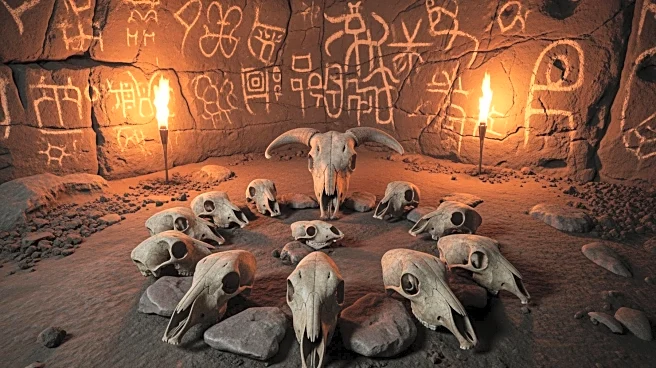
Archaeologists have discovered that Neanderthals collected and arranged animal skulls in a cave in Spain over 43,000 years ago, indicating complex cultural behaviors. The Des-Cubierta cave, found in central Iberia, contained 35 large mammal skulls, primarily
from horned or antlered species, alongside over 1,400 stone tools. This suggests that Neanderthals engaged in cultural practices not directly related to survival. The study, published in the journal Archaeological and Anthropological Sciences, highlights the Neanderthals' capacity for symbolic behavior, challenging previous assumptions about their cognitive abilities.
Why It's Important?
This discovery provides significant insights into the cultural and symbolic practices of Neanderthals, suggesting they had complex social structures and traditions. Understanding these behaviors helps redefine the narrative of human evolution, highlighting the similarities between Neanderthals and modern humans. The findings challenge the perception of Neanderthals as primitive and underscore their ability to engage in activities beyond mere survival. This research contributes to the broader understanding of human history and the development of cultural practices, offering a more nuanced view of our evolutionary relatives.
Beyond the Headlines
The study of Neanderthal cultural practices opens up new avenues for exploring the evolution of human cognition and social behavior. The deliberate collection and arrangement of animal skulls suggest a form of symbolic expression, potentially linked to rituals or social cohesion. This challenges the traditional view of Neanderthals and prompts a reevaluation of their role in the human evolutionary story. The research also highlights the importance of interdisciplinary approaches in archaeology, combining geological and anthropological methods to uncover the complexities of ancient human societies.