




What's Happening?
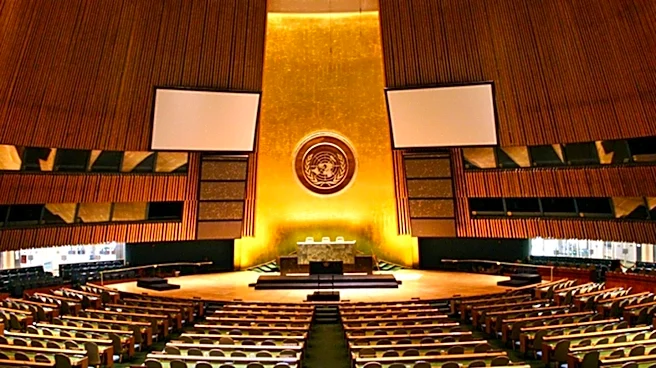
Experts at a joint meeting of the United Nations (UN) First Committee – Disarmament and International Security and Fourth Committee – Special Political and Decolonization on October 29 warned that space debris collision is no longer hypothetical. Darren
McKnight, Senior Technical Fellow for LeoLabs, highlighted that the number of objects in low Earth orbit has doubled since 2020, with his organization tracking nearly 29,000 objects daily. He noted that 90% of objects below 650 kilometers are operational payloads, while above that altitude, 90% are debris. McKnight specifically pointed to three clusters of dead objects in low Earth orbit that pose a significant collision risk, with probabilities ranging from 5% to 50% by 2030. Aarti Holla-Maini, Director of the United Nations Office for Outer Space Affairs, emphasized the need for global alignment on guidelines for on-orbit servicing and active debris removal, urging governments to ensure maximum satellite safety if they are unwilling to limit launches. Adedeji Ebo, Director and Deputy to the UN’s High Representative for Disarmament Affairs, also raised concerns about allegations of nuclear weapons development in orbit and the placement of space control weapons.
Why It's Important?
The increasing density of space debris poses a significant threat to operational satellites and future space missions, which are crucial for various U.S. industries, including telecommunications, navigation, weather forecasting, and national security. A major collision could lead to a cascade effect, generating even more debris and potentially rendering certain orbital paths unusable for decades or centuries. This would disrupt essential services reliant on satellite technology, impacting everything from GPS-guided transportation and precision agriculture to internet connectivity and military intelligence. The call for global guidelines and active debris removal highlights the urgent need for international cooperation to protect a shared and vital resource. The allegations of nuclear weapons development in orbit, as noted by Adedeji Ebo, further underscore the geopolitical implications and the potential for space to become a new domain for conflict, necessitating robust disarmament and arms control discussions.
What's Next?
Meeting delegates called for more joint dialogue to address the build-up of geopolitical tensions and their impact on space and airspace safety. The discussions are expected to continue within UN frameworks, potentially leading to new international agreements or strengthened existing guidelines for space traffic management and debris mitigation. Nick Shave, Managing Director of Astroscale United Kingdom, discussed the technology for on-orbit servicing, suggesting that technological solutions are being developed to address the problem. Japan's 2021 on-orbit servicing guidelines, which promote transparency, define 'keep-out zones,' and require data sharing, could serve as a model for other nations. The focus will likely be on developing and implementing global standards for spacecraft design, operation, and end-of-life disposal, as well as exploring active debris removal technologies to prevent catastrophic collisions and ensure the long-term sustainability of space activities.
Beyond the Headlines
The issue of space debris extends beyond immediate operational risks, touching upon broader questions of international law, environmental stewardship, and the militarization of space. The 'tragedy of the commons' applies directly to low Earth orbit, where individual actors benefit from launching satellites but the collective burden of debris impacts everyone. The development of on-orbit servicing and active debris removal technologies also raises ethical considerations regarding ownership of debris, the potential for dual-use technologies (e.g., for debris removal or as anti-satellite weapons), and the equitable distribution of costs and benefits for space cleanup. The allegations of weapons in orbit highlight a critical need for transparency and verifiable arms control measures in space to prevent an arms race and maintain the peaceful use of outer space, a principle enshrined in international treaties but increasingly challenged by technological advancements and geopolitical rivalries.