



What's Happening?
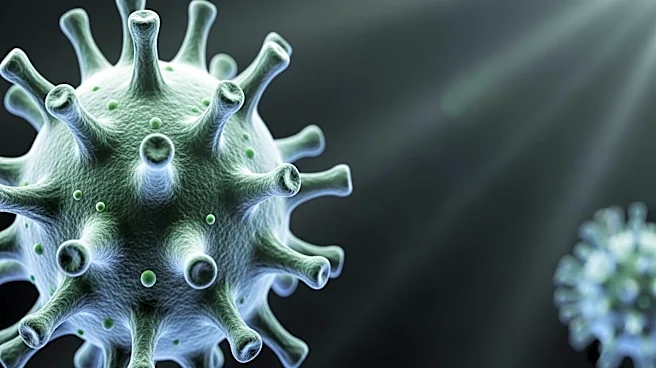
The Centers for Disease Control and Prevention (CDC) has identified a new Covid-19 variant, BA.3.2, in 29 U.S. states and Puerto Rico. This variant, a subvariant of Omicron, features numerous spike protein mutations. Despite its emergence, experts, including
Dr. Jake Scott from Stanford, emphasize that there is no current evidence suggesting BA.3.2 is more severe than other variants. The World Health Organization (WHO) has classified it as a 'variant under monitoring' but has not elevated it to a higher risk category. Current vaccines continue to provide protection against severe illness, and public health measures such as masking and improved ventilation are recommended in high-risk settings. The variant has not shown a significant growth advantage over other variants, and there is no indication of increased severity or hospitalizations associated with it.
Why It's Important?
The emergence of BA.3.2 highlights the ongoing evolution of the Covid-19 virus and the importance of continued vigilance in monitoring new variants. While the variant has not demonstrated increased severity, its detection underscores the need for ongoing vaccine updates and public health strategies to mitigate potential risks. The ability of current vaccines to protect against severe disease remains crucial, particularly as new variants arise. The situation also emphasizes the importance of global data sharing and collaboration in tracking and responding to Covid-19 developments. The overrepresentation of BA.3.2 in pediatric samples raises questions about its transmission dynamics, although experts caution against drawing premature conclusions about its impact on children.
What's Next?
Researchers and public health officials will continue to monitor BA.3.2 to assess its impact and inform potential updates to vaccines. The WHO's upcoming meeting in May will further discuss the variant's implications for vaccine composition. Public health guidance may evolve as more data becomes available, but for now, existing measures remain effective. The focus will remain on preventing severe outcomes and hospitalizations, rather than eliminating all infections. Continued vigilance and adaptation of public health strategies will be essential as the situation develops.