





What's Happening?
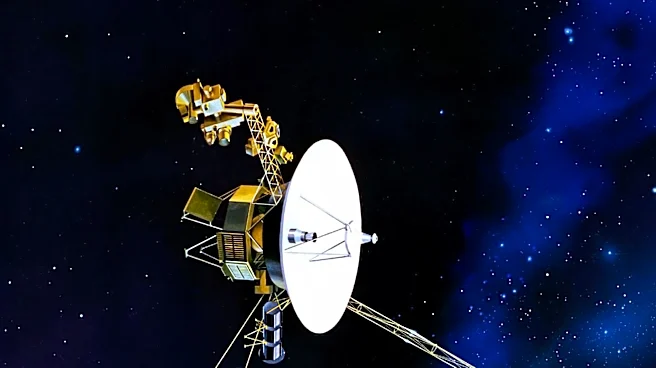
Voyager 2, a spacecraft launched by NASA, is currently on a trajectory that places it far below the plane of the solar system, making it reliant on a single 70-meter antenna located at the Canberra Deep Space Communication Complex in Australia for receiving
commands. This antenna, known as Deep Space Station 43 (DSS-43), is the only one capable of sending commands to Voyager 2 due to its specific location and technical capabilities. In 2020, DSS-43 underwent significant maintenance, which temporarily halted communication with the spacecraft. Despite this, Voyager 2 continued to send data back to Earth, although it could not receive new instructions during this period. The maintenance was necessary to replace aging components and ensure the continued operation of the antenna, which is crucial for maintaining contact with the spacecraft as it travels through interstellar space.
Why It's Important?
The reliance on a single antenna for communication with Voyager 2 highlights the challenges of deep-space exploration and the importance of maintaining critical infrastructure. The situation underscores the complexity of managing long-term space missions, where communication is vital for the continued collection of scientific data. The successful maintenance of DSS-43 ensures that NASA can continue to receive valuable information from Voyager 2, which is exploring regions of space beyond the heliosphere. This data is crucial for understanding the outer reaches of our solar system and the interstellar environment. The incident also illustrates the delicate balance between technological advancement and the need for ongoing maintenance of existing systems to support scientific exploration.
What's Next?
With the completion of the maintenance on DSS-43, NASA can continue to send commands to Voyager 2, allowing the mission to proceed as planned. The spacecraft will keep transmitting data back to Earth, contributing to our understanding of interstellar space. Future challenges may include managing the aging spacecraft's systems and ensuring that communication remains uninterrupted. NASA will likely continue to monitor the performance of DSS-43 and other components of the Deep Space Network to prevent any future disruptions. The lessons learned from this experience may inform the planning and execution of future deep-space missions, emphasizing the need for robust and reliable communication infrastructure.