





What's Happening?
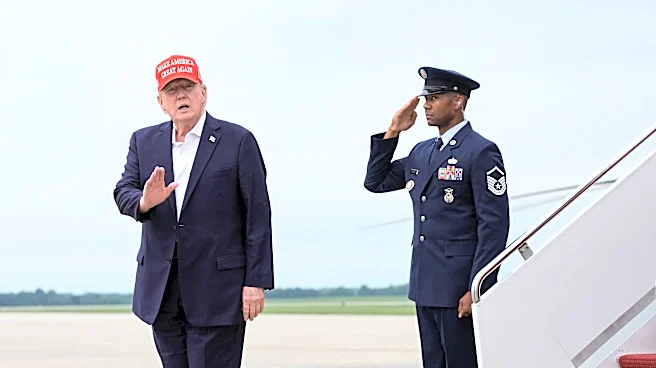
President Trump has instructed the Pentagon to "substantially reduce" joint military exercises with South Korea, specifically the Ulchi Freedom Shield drills. This directive, announced via his Truth Social platform, came hours before the exercises were
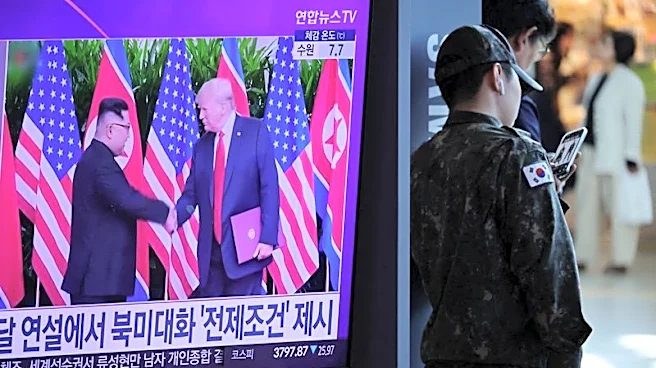
scheduled to begin. President Trump cited the high cost of the drills, largely borne by the United States, and South Korea's refusal to join U.S. efforts to denuclearize Iran as primary reasons for his decision. He also highlighted his "very good relationship" with North Korean leader Kim Jong Un, stating that the exercises send an "inappropriate and hostile" signal to a country he considers unthreatening and respectful during his presidency. The annual Ulchi Freedom Shield exercises were slated to run until August 27, involving approximately 18,000 South Korean military personnel. South Korea's Joint Chiefs of Staff confirmed the drills commenced as scheduled, while the presidential Blue House stated it was reviewing President Trump's post and expressed hope for meaningful dialogue between the U.S. and North Korea.
Why It's Important?
This decision by President Trump carries significant implications for U.S. alliances, regional stability in East Asia, and the ongoing dynamics with North Korea. Reducing joint military exercises could be perceived as a weakening of the U.S.-South Korea alliance, potentially undermining deterrence against North Korean aggression. Military analysts have voiced concerns that such a move could compromise military readiness and the interoperability of U.S. and South Korean forces. Furthermore, linking the military exercises to South Korea's stance on Iran introduces a new dimension to alliance relations, suggesting that U.S. security cooperation may be contingent on alignment with broader U.S. foreign policy objectives. The move also risks emboldening North Korea, which routinely denounces these exercises as preparations for invasion, and could complicate future denuclearization efforts by signaling a willingness to make concessions without reciprocal actions from Pyongyang. The financial argument for reducing drills also raises questions about the perceived value of alliance commitments versus direct monetary costs.
What's Next?
The immediate future will likely involve close monitoring of how the Ulchi Freedom Shield exercises proceed and the extent of any actual reduction in scope or intensity. South Korea has indicated it will continue coordinating on combined defense posture and military exercises, suggesting potential negotiations or adjustments rather than an outright cancellation. North Korea's reaction will be crucial; while some experts believe Pyongyang might not feel immediate pressure to return to talks, President Trump's overture is unlikely to be entirely ignored. The Pentagon's response to President Trump's directive and any subsequent clarification from the White House will also be key in understanding the practical implementation of this order. Additionally, the decision could prompt further discussions within South Korea regarding its defense strategy and reliance on the U.S., potentially fueling debates about increased self-reliance or alternative security arrangements. The broader implications for U.S. foreign policy, particularly regarding its alliances and engagement in the Indo-Pacific, will also be a focal point.
Beyond the Headlines
President Trump's directive extends beyond immediate military readiness, touching upon deeper issues of alliance reliability and the transactional nature of international relations. The move could foster uncertainty among U.S. allies globally, prompting them to question the long-term commitment and predictability of U.S. security guarantees. By publicly criticizing an ally over its foreign policy choices (regarding Iran) and linking it to defense cooperation, President Trump introduces a precedent that could strain other alliances. This approach might encourage adversaries to test the resolve of U.S. alliances, potentially leading to increased regional instability. Furthermore, the emphasis on personal relationships with leaders like Kim Jong Un over established diplomatic and military protocols raises questions about the consistency and institutional strength of U.S. foreign policy. The decision also highlights ongoing tensions between economic considerations (cost of drills) and strategic imperatives (alliance strength and deterrence), a recurring theme in President Trump's foreign policy approach.