
What's Happening?
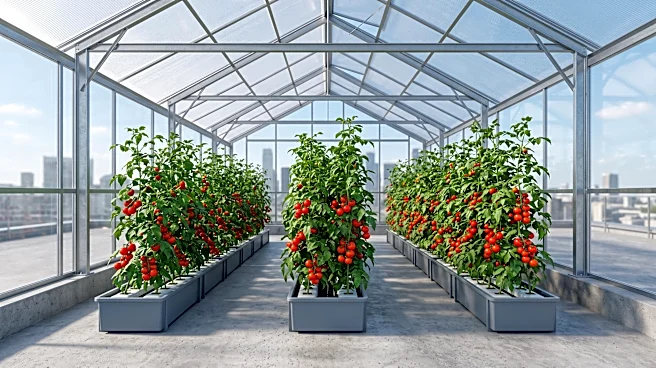
An eight-year analysis conducted by ICTA-UAB, evaluating 11 tomato crop cycles between 2015 and 2023 in a building-integrated rooftop greenhouse, has identified critical factors for optimizing sustainable
urban food production. The study, published in Agronomy for Sustainable Development, found that sunlight is the most decisive factor for crop productivity. Degradation of plastic roof panels led to a 31% decline in production over the study period, with yields surging by over 56% after panel replacement in 2023. Researchers recommend replacing these panels every four to six years, rather than the manufacturer-suggested 10 years, to maintain high productivity and reduce carbon footprint. Additionally, the research highlighted the effectiveness of struvite, a phosphorus-rich fertilizer recovered from municipal wastewater, which matched conventional fertilizer yields while significantly reducing water pollution from runoff. The study also compared the rooftop greenhouse with indoor LED cultivation, finding the latter to have a much higher environmental footprint unless powered by renewable energy sources.
Why It's Important?
This research provides crucial insights for the growing urban agriculture sector in the U.S., offering practical, data-driven strategies to enhance sustainability and productivity. By identifying sunlight as the primary yield driver and recommending more frequent replacement of greenhouse roof panels, urban farms can significantly boost their output and economic viability. The successful use of wastewater-recovered struvite as a fertilizer presents a dual benefit: it provides an effective nutrient source for crops and addresses environmental concerns by reducing nutrient pollution in water bodies. This innovation could lead to more circular economy practices within urban food systems, lessening reliance on conventional fertilizers and mitigating their ecological impact. The comparison with indoor LED cultivation underscores the importance of renewable energy integration for such systems, guiding future investments and policy decisions towards truly sustainable urban farming models and potentially influencing urban planning and agricultural subsidies.
What's Next?
The findings from this eight-year study are expected to inform best practices for urban farms and rooftop greenhouses globally, including those in the U.S. Urban agriculture initiatives may adopt the recommendation for more frequent replacement of greenhouse roof panels to maximize yields and reduce environmental impact. Further research and development could focus on optimizing the recovery and application of wastewater-derived fertilizers like struvite, potentially leading to wider adoption in commercial urban farming operations. Policy discussions around urban planning, agricultural subsidies, and environmental regulations may incorporate these findings to promote more sustainable and efficient urban food production systems. Additionally, the study's emphasis on renewable energy for indoor farming could drive innovation and investment in solar-powered vertical farms and other controlled environment agriculture technologies.
Beyond the Headlines
The study's 'learning by doing' approach highlights a broader shift in sustainable development, emphasizing continuous adaptation and precise adjustments over one-time solutions. This iterative methodology is crucial for addressing complex environmental challenges in urban settings. The successful integration of wastewater-derived fertilizers like struvite points to a future where urban waste streams are not just managed but actively repurposed as valuable resources, fostering a more circular and resilient urban ecosystem. This could lead to a re-evaluation of waste management policies and infrastructure, transforming urban areas into more self-sufficient food producers. Furthermore, the research implicitly challenges the perception that all high-tech farming solutions are inherently sustainable, underscoring the critical role of energy sources in determining the true environmental footprint of advanced agricultural practices, particularly in the context of climate change and resource scarcity.