




What's Happening?
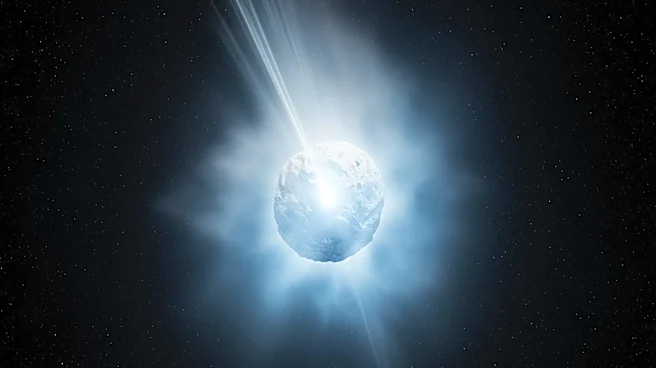
A team of astronomers led by Elisabeth Matthews at the Max Planck Institute for Astronomy has discovered water-ice clouds on the exoplanet Epsilon Indi Ab, a Jupiter-like planet. This finding challenges existing models of exoplanet atmospheres, which
often do not account for clouds due to computational complexity. The study, published in The Astrophysical Journal Letters, utilized the James Webb Space Telescope (JWST) to capture direct images of the planet, revealing ammonia and suggesting the presence of thick clouds. This discovery is significant as it represents a step towards understanding the atmospheres of solar-system analog planets, potentially paving the way for future studies on Earth-like exoplanets.
Why It's Important?
The discovery of water-ice clouds on Epsilon Indi Ab is crucial for advancing exoplanet research, particularly in understanding atmospheric compositions. This finding highlights the limitations of current atmospheric models and underscores the need for more sophisticated simulations that include cloud dynamics. The research also demonstrates the capabilities of the JWST in providing detailed atmospheric data, which is essential for the long-term goal of detecting life on exoplanets. The presence of clouds adds complexity to atmospheric studies, but it also opens new avenues for characterizing distant worlds, enhancing our understanding of planetary formation and evolution.
What's Next?
Future observations are planned using the upcoming Nancy Grace Roman Space Telescope, which is expected to launch in 2026-2027. This telescope will be capable of observing the reflective water-ice clouds directly, providing further insights into the atmospheric conditions of Epsilon Indi Ab. Additionally, the research team is applying for more observation time with the JWST to study other cold Jupiter-analogs. These efforts aim to refine observational techniques and lay the groundwork for targeting Earth-like planets in the search for extraterrestrial life.