








What's Happening?
Mexican federal authorities have dismantled clandestine cryptocurrency mining facilities in Tlaola, Puebla, and Culiacán, Sinaloa, believed to be operated by the Jalisco New Generation Cartel (CJNG) and other criminal groups. In Tlaola, an operation by Mexico’s
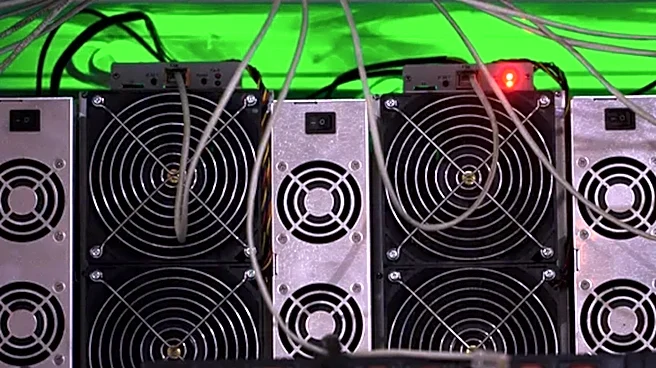
Navy Ministry and the Public Security Secretariat seized over 100 graphics cards, 50 state-of-the-art computers, and an industrial-grade electrical transformer from an isolated property. This discovery was made after drones detected 'unusual' thermal radiation. The facility was illegally connected to Mexico’s Federal Electricity Commission (CFE) grid. Separately, in Culiacán, Sinaloa, state police seized 130 computers, three transformers, and a video-surveillance system from another illegal mining operation. These are not isolated incidents, as other such centers have been dismantled in Tlaxcala since last year, indicating a growing trend of cartels utilizing cryptocurrency mining.
Why It's Important?
This development signifies a concerning evolution in the financial strategies of Mexican cartels, as they increasingly leverage sophisticated technology like cryptocurrency mining for money laundering and revenue generation. The high electricity consumption and specialized equipment required for mining, often illegally sourced or connected, highlight the cartels' resourcefulness and their ability to exploit emerging technologies. According to financial crime specialist Luisa María Acosta, organized crime groups are not abandoning traditional money-laundering channels but are integrating cryptoassets due to their pseudonymity and rapid transaction speeds, making them harder for authorities to trace. This shift poses a significant challenge for law enforcement agencies in Mexico and internationally, as they adapt to new methods of financial crime.
What's Next?
Authorities in Puebla are pursuing further investigations into the presence of more cryptocurrency farms in the municipality and neighboring areas. The next crucial step in these investigations is to identify the cryptocurrency wallets used by these operations to determine the extent of money laundering. The ongoing nature of these discoveries suggests a need for enhanced technological surveillance and expertise within law enforcement to combat this evolving threat. International cooperation may also become increasingly vital, as the decentralized and global nature of cryptocurrencies means that cartel financial networks can extend beyond national borders.
Beyond the Headlines
The expansion of Mexican cartels into cryptocurrency mining reveals a deeper implication: the increasing sophistication and diversification of their criminal enterprises. This move not only provides new avenues for illicit gains but also presents a complex legal and ethical dilemma. While cryptocurrency mining itself is not illegal, its use by criminal organizations, coupled with electricity theft, highlights a significant regulatory gap. The negative public perception of cryptocurrency mining, partly fueled by these illegal activities, could also impact legitimate operators in the sector. This trend underscores the urgent need for governments worldwide to develop comprehensive regulatory frameworks for cryptocurrencies and to invest in advanced forensic capabilities to track and disrupt these digital financial flows.