





What's Happening?
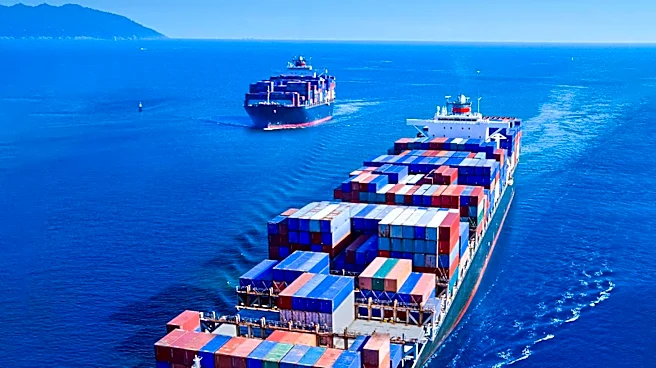
The global economy's reliance on a limited number of maritime trade routes, known as chokepoints, is increasingly vulnerable to geopolitical conflicts and weaponization. Approximately 90% of global trade is transported by sea, with a significant portion
passing through narrow straits and canals. Recent military escalations in the Middle East, such as the closure of the Strait of Hormuz and Houthi missile strikes in the Bab el-Mandeb Strait, have caused severe disruptions, leading to soaring freight rates, delayed transits, and market volatility. The Strait of Malacca, a critical East Asian maritime highway, is also nearing its capacity limits, prompting proposals for alternative routes like Thailand's landbridge railway. These events highlight the limitations of international maritime law in safeguarding global commerce, as weak enforcement mechanisms prove insufficient against the immediate security interests of regional and global powers. Coastal nations and militant groups are leveraging these chokepoints in geopolitical disputes, forcing global supply chains to adapt to a more volatile reality.
Why It's Important?
The weaponization of maritime chokepoints has significant implications for the U.S. and the global economy. Disruptions in these vital passages directly impact the cost and availability of goods, affecting industries reliant on international trade. For U.S. businesses and consumers, this translates to higher prices for imported goods, potential shortages, and increased operational costs for companies. The shift from 'just-in-time' to more resilient logistics strategies, involving larger emergency inventories and diversified shipping routes, will require substantial investment and could alter global trade patterns. The vulnerability of these routes also poses national security concerns, as the flow of critical resources like oil and gas can be interrupted, impacting energy markets and strategic alliances. The erosion of international maritime law's effectiveness underscores a broader challenge to global governance and stability, potentially leading to a more fragmented and unpredictable international trade environment.
What's Next?
In response to the increasing volatility, international businesses and importing nations are expected to accelerate their transition towards highly resilient logistics strategies. This will likely involve maintaining larger emergency inventories, partnering with multiple transportation providers, and actively diversifying shipping routes to mitigate localized disruptions. Efforts to establish stronger, cooperative enforcement mechanisms for maritime commons will be crucial, though their implementation faces significant geopolitical hurdles. The development of alternative trade routes, such as the proposed Thai landbridge to bypass the Malacca Strait and the Arctic's Polar Silk Road, will continue to be explored, albeit with their own operational, environmental, and political challenges. The U.S. and its allies may also increase their focus on naval presence and security operations in critical maritime areas to protect trade flows and counter potential threats.
Beyond the Headlines
The ongoing weaponization of maritime chokepoints reveals a deeper shift in global power dynamics and the effectiveness of international law. The United Nations Convention on the Law of the Sea, once an optimistic framework for free transit, is proving inadequate in an era of heightened geopolitical tension. This situation could lead to a re-evaluation of international legal frameworks and the need for new mechanisms to ensure the security of global commerce. Ethically, the impact on everyday consumers, who ultimately bear the costs of these disruptions, raises questions about equitable access to essential goods and the responsibilities of global powers. Culturally, the increased focus on supply chain resilience may foster a greater appreciation for the complex interdependencies of the global economy and the often-unseen infrastructure that supports modern life. The long-term shifts could include a move towards more regionalized supply chains and a re-prioritization of national security interests over purely economic efficiencies.