

What's Happening?
The James Webb Space Telescope (JWST) launched on December 25, 2021, from the Guiana Space Centre, marking a significant milestone in space exploration. Developed by NASA, the European Space Agency, and the Canadian Space Agency, the telescope is positioned
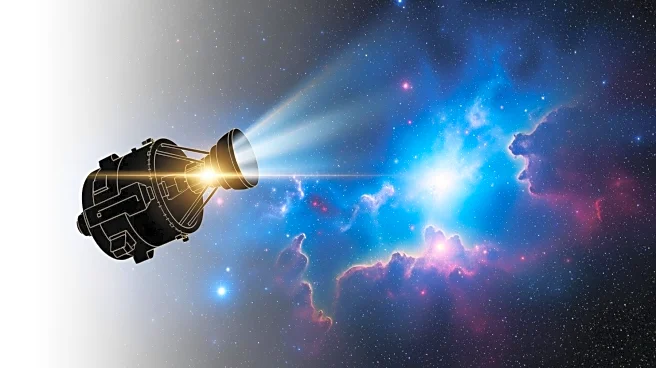
at a Lagrange point, allowing it to capture unprecedented images of the universe. JWST has provided insights into the early universe, confirming the Hubble tension and discovering potentially life-sustaining atmospheres on distant exoplanets.
Why It's Important?
The launch and operation of the James Webb Space Telescope have transformed our understanding of the cosmos. By observing the universe's earliest epochs, JWST has challenged existing cosmological models and expanded knowledge of galaxy formation and black holes. Its ability to detect infrared signals from ancient starlight offers new opportunities for discovering exoplanets and studying their atmospheres, potentially identifying signs of life beyond Earth.
What's Next?
As JWST continues to collect data, scientists anticipate further breakthroughs in understanding the universe's origins and the nature of distant celestial bodies. The telescope's findings will guide future research and exploration missions, shaping the direction of astrophysics and space science. Continued international collaboration and technological advancements will be crucial for maximizing the telescope's potential and uncovering new cosmic phenomena.