
What's Happening?
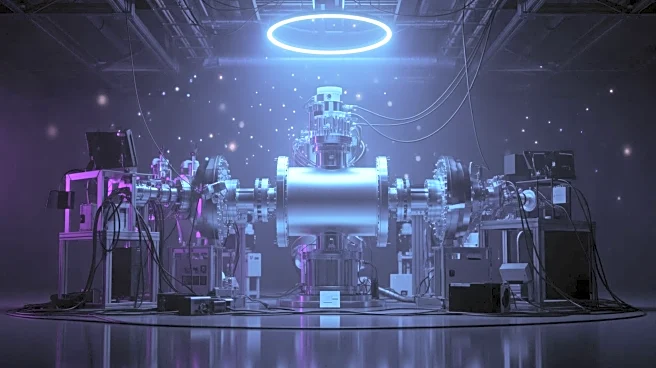
The LUX-ZEPLIN (LZ) experiment, conducted in South Dakota, has provided new insights into dark matter and solar neutrinos. Although the experiment did not confirm the presence of dark matter, it constrained
the properties of weakly interacting massive particles (WIMPs) with unprecedented sensitivity. The study also improved confidence in detecting solar neutrinos, specifically boron-8, which could help avoid false detections in future dark matter research. The findings contribute to the ongoing quest to understand the universe's composition and the role of dark matter.
Why It's Important?
This experiment represents a significant step in the search for dark matter, a mysterious substance believed to make up most of the universe's matter. By refining detection methods and improving sensitivity, the study enhances the ability to identify dark matter and understand its properties. The results also advance knowledge of neutrinos, fundamental particles that play a crucial role in particle physics and cosmology. These findings could lead to breakthroughs in understanding the universe's structure and the forces that govern it.
What's Next?
The LZ experiment will continue with a longer run planned for 2028, aiming to collect data over 1,000 days. This extended observation period will increase the chances of detecting rare events and provide more opportunities to study dark matter and neutrinos. Future research will focus on refining detection techniques and exploring new physics beyond the Standard Model, potentially leading to groundbreaking discoveries in particle physics and cosmology.