






What's Happening?
NASA has successfully conducted a balloon test of its Compact Large-sensor Imaging Camera (CLIC 2), a self-guided terrain camera designed for future Moon and Mars missions. Launched from Fort Sumner, New Mexico, the payload reached an altitude of approximately
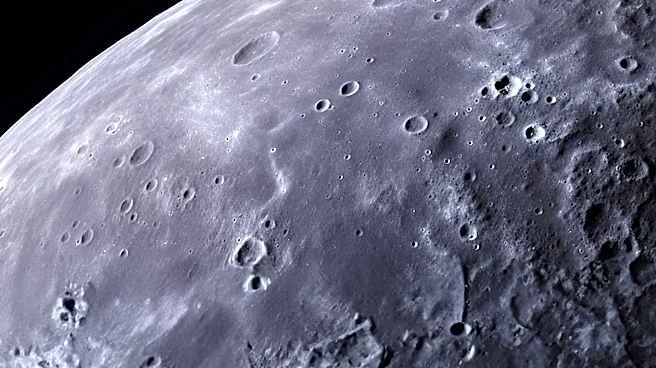
126,000 feet, operating for nearly four hours in a near-space environment. The CLIC 2 system is crucial because it processes terrain data autonomously and in real-time during descent, without requiring signals from Earth. This capability is vital for safe landings in rugged, scientifically interesting terrains that are inaccessible to older spacecraft. The test is part of NASA's broader Safe and Precise Landing Integrated Capabilities Evolution (SPLICE) program, which aims to develop a full suite of sensors and computing power to achieve highly accurate landings, such as the 50-meter target for Artemis crewed lunar missions.
Why It's Important?
This test is a critical step for the U.S. space program, particularly for the Artemis missions aiming to return humans to the Moon and eventually Mars. The ability for spacecraft to autonomously identify and avoid hazards during landing is paramount for mission success and astronaut safety. Current communication delays make real-time human intervention impossible during critical descent phases. By enabling precision landings in challenging environments, CLIC 2 and the SPLICE program expand potential landing sites beyond flat, safe areas to include scientifically rich, but hazardous, regions like the lunar south pole. This technology directly contributes to NASA's goal of establishing a sustainable human presence on the Moon and preparing for human exploration of Mars, enhancing the U.S.'s leadership in space exploration and scientific discovery.
What's Next?
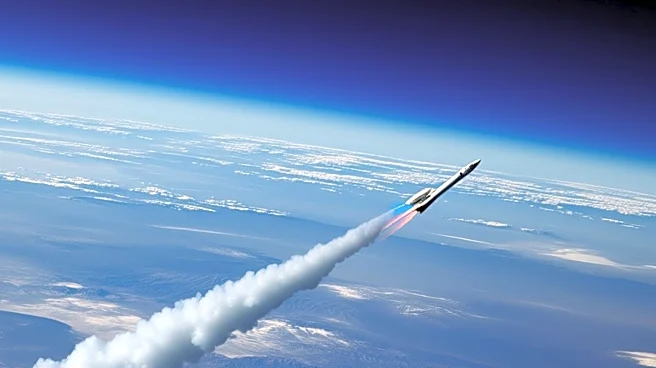
The successful CLIC 2 balloon flight provides valuable engineering data that will be used to refine the camera and image-processing pipeline. The system will undergo further testing, including planned suborbital rocket flights later in 2026, to validate its performance under more extreme conditions of speed and g-forces. Ultimately, the technology will need to be integrated into actual landers for final validation. NASA's SPLICE program will continue to develop other components, such as Navigation Doppler Lidar and Hazard Detection Lidar, to create a comprehensive precision landing system. The ongoing Fort Sumner balloon campaign will also continue to test other scientific experiments and technology demonstrations, contributing to the overall maturation of technologies essential for future space missions.
Beyond the Headlines
The development of self-guided terrain cameras and autonomous landing systems represents a profound shift in space exploration, moving towards greater autonomy for spacecraft. This technological leap has implications beyond space, potentially influencing autonomous navigation systems for terrestrial applications, such as self-driving vehicles or advanced robotics in hazardous environments. Ethically, it raises questions about the increasing reliance on AI for critical decision-making in high-stakes missions. Culturally, it reinforces humanity's drive to explore and push the boundaries of technology, inspiring future generations in STEM fields. The ability to land precisely in previously unreachable areas could unlock new scientific discoveries about the Moon and Mars, potentially revealing insights into the origins of our solar system and the possibility of extraterrestrial life, thereby expanding our cosmic understanding.