




What's Happening?
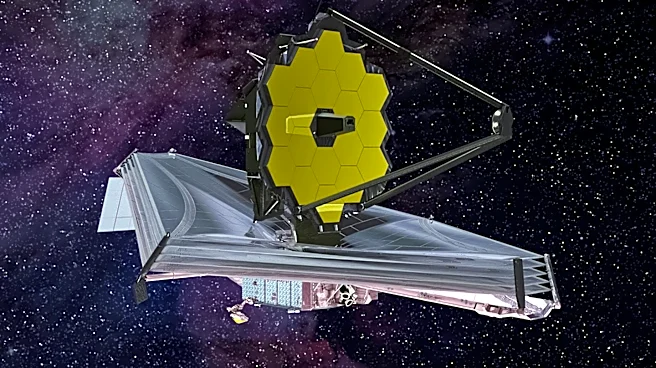
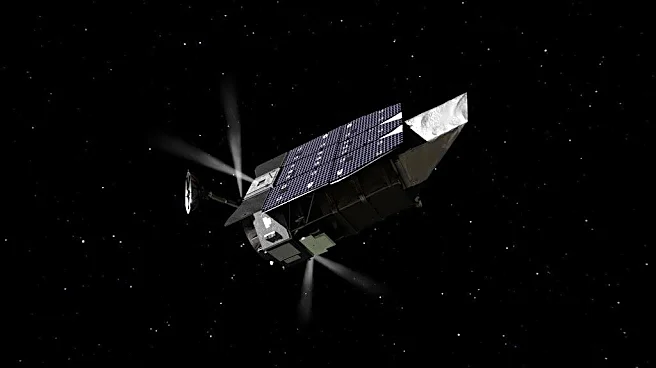
Project Hephaistos, an ongoing cosmic survey at Uppsala University in Sweden, has utilized the James Webb Space Telescope (JWST) to investigate potential Dyson spheres around two faint M-dwarf stars. Dyson spheres are hypothetical megastructures built
by advanced alien civilizations to harness the energy of an entire star. Researchers, including Uppsala University astrophysicist Andreas Korn, had previously identified these dwarf stars using the European Space Agency’s Gaia satellite and NASA’s Wide-field Infrared Survey Explorer (WISE) due to their 'unusual infrared properties'—specifically, unexpectedly low optical fluxes and higher infrared fluxes, which could indicate waste heat from a Dyson sphere. However, the more focused observations by the JWST revealed that these stars are not surrounded by such structures but are instead standard M dwarfs whose energy signatures were blended with background galaxies in earlier, less precise observations.
Why It's Important?
This finding is significant for the field of astrobiology and the search for extraterrestrial intelligence (SETI). While disappointing for those hoping to find evidence of advanced alien civilizations, it demonstrates the critical role of advanced observational tools like the JWST in refining our understanding of cosmic phenomena. The ability of the JWST to distinguish between the light from distant stars and background galaxies, a capability that previous telescopes like WISE lacked, is crucial for accurately identifying technosignatures. This precision helps scientists avoid false positives and focus their search efforts more effectively. The ongoing Project Hephaistos exemplifies the systematic approach to searching for Dyson spheres, which are considered one of the most plausible technosignatures of highly advanced civilizations. The continuous refinement of search methodologies and the use of cutting-edge technology are vital for making progress in this complex scientific endeavor.
What's Next?
Despite the current debunking of these specific Dyson sphere candidates, the search for extraterrestrial technosignatures will continue. Project Hephaistos will likely continue to analyze other potential candidates, leveraging the JWST's capabilities and incorporating data from future telescopes. Several proposed mid-infrared telescopes, such as the Giant Magellan Telescope, are scheduled to become operational by the 2030s. These new instruments are expected to offer even greater resolution and sensitivity, further enhancing scientists' ability to differentiate between natural cosmic phenomena and potential artificial structures. The experience gained from this investigation will inform future search strategies, emphasizing the need for high-resolution observations to confirm or refute initial findings. The scientific community will continue to develop and refine theoretical models for what Dyson spheres and other technosignatures might look like, guiding the next generation of observational campaigns.
Beyond the Headlines
The search for Dyson spheres touches upon profound questions about the limits of technological advancement and the potential scale of alien civilizations. The concept, initially described by physicist Freeman Dyson, posits that a civilization's energy needs would eventually necessitate harnessing the entire output of its star. While the current findings did not confirm such structures, the very act of searching for them pushes the boundaries of astronomical observation and theoretical physics. It also highlights the challenges inherent in SETI—distinguishing between natural cosmic processes and deliberate artificial constructs. The 'waste heat' signature, in the form of excess mid-infrared radiation, remains a key theoretical indicator for Dyson spheres, underscoring the importance of understanding energy thermodynamics on a cosmic scale. This ongoing quest not only seeks to answer whether we are alone but also provides a mirror for humanity to consider its own long-term energy consumption and technological trajectory.