
What's Happening?
Researchers at Northeast Normal University in China have developed a self-healing pain sensor made from gelatin, which mimics the adaptive and memory-like properties of biological nociceptors. This innovation
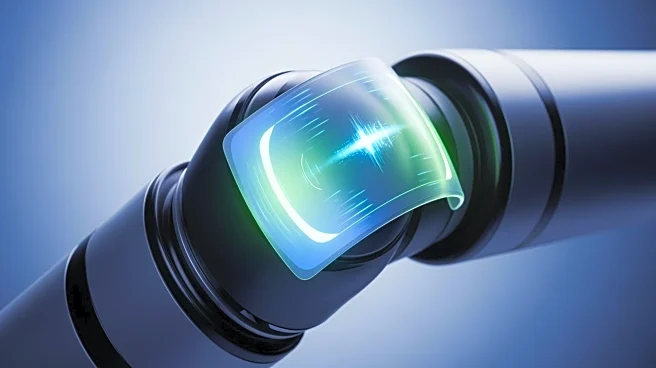
involves a memristor with 16 stable conductance states that can rate pain intensity, become hypersensitive after injury, and self-heal. The memristor, a two-terminal electronic component, uses a thin gelatin layer sandwiched between magnesium and nickel electrodes. This setup allows the device to mimic biological pain perception by encoding pain intensity and adapting to injury. The sensor is part of a bio-electronic system that converts mechanical pressure into electrical signals, directly stimulating muscle contraction in a mouse model. This development could significantly enhance the functionality of humanoid robots and advanced prosthetics by providing them with nuanced pain detection capabilities.
Why It's Important?
The development of a self-healing pain sensor represents a significant advancement in robotics and prosthetics. By enabling robots to distinguish between different levels of pressure and respond to injuries, this technology could improve the safety and efficiency of robots operating in complex environments. It also holds potential for neuroprosthetic applications, offering new strategies for managing chronic pain through engineered nerve interfaces. The ability to mimic biological pain responses in artificial systems could lead to more adaptive and self-protecting robotic technologies, enhancing their integration into human environments and tasks.
What's Next?
Future research may focus on refining the sensor's capabilities, such as reducing the healing temperature to make it more compatible with biological systems. Additionally, further development could explore integrating this technology into commercial robotic and prosthetic applications, potentially revolutionizing how these devices interact with their environments. The approach may also inspire new designs in neuroprosthetics, offering improved solutions for individuals with sensory impairments.