



What's Happening?
The interstellar comet 3I/ATLAS, which has been under observation since its discovery near Jupiter on July 1, 2025, has been confirmed by scientists to be a natural comet rather than an alien spacecraft. This conclusion comes after a thorough search for
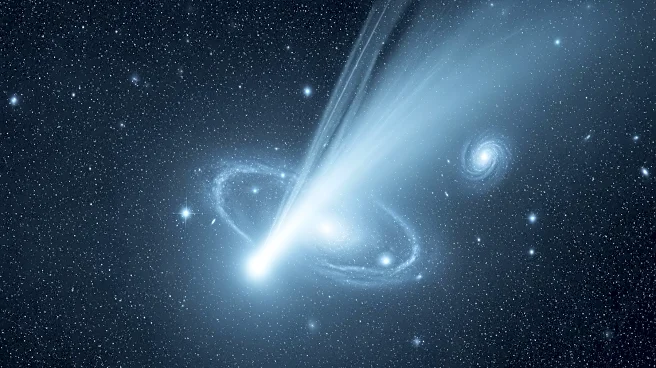
technosignatures by Breakthrough Listen, an international group dedicated to finding intelligent life in the universe. Using the Green Bank Telescope, researchers searched for radio or laser signals as strong as a modern cellphone but found none above the 100 milliwatt level. The comet, which made its closest approach to Earth in December 2025, has been closely monitored by various space agencies, including NASA and the European Space Agency. Images captured by the Hubble Space Telescope revealed a teardrop-shaped plume of dust around its nucleus, further supporting its classification as a natural comet.
Why It's Important?
The confirmation that 3I/ATLAS is not an alien spacecraft is significant as it dispels widespread speculation and curiosity about the possibility of extraterrestrial technology. This finding underscores the importance of scientific rigor and evidence-based conclusions in the study of interstellar objects. The research conducted by Breakthrough Listen and other agencies highlights the capabilities of modern astronomical tools and techniques in distinguishing natural celestial phenomena from potential artificial constructs. This event also emphasizes the ongoing interest and investment in the search for extraterrestrial life, a field that continues to captivate both the scientific community and the public.
What's Next?
As 3I/ATLAS continues its journey through the solar system, it will be monitored by the European Space Agency's Juice spacecraft, which is en route to Jupiter and its icy moons. The comet is expected to reappear in December on the other side of the sun, providing further opportunities for observation and study. The ongoing analysis of 3I/ATLAS and similar interstellar objects will contribute to our understanding of the dynamics and composition of such bodies, potentially offering insights into the processes that govern their formation and behavior.