







What's Happening?
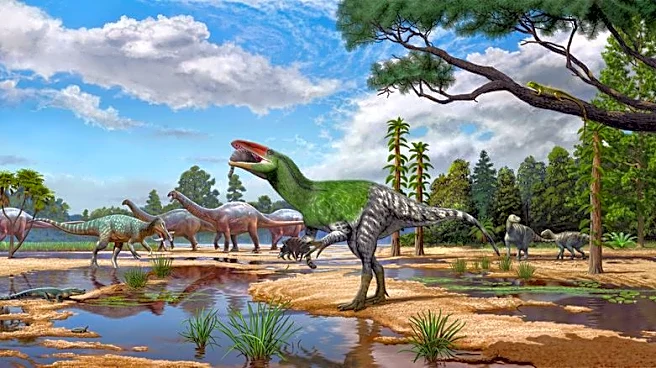
A fragment of a dinosaur skull, held in a museum collection for approximately a century, has been identified as belonging to an entirely new species of carnivorous dinosaur, named Invictibellatrix amberina. This discovery marks Europe's first known megaraptoran,
a group of formidable prehistoric predators previously identified in Asia, Australia, and South America. The fossil, originally from the Isle of Wight, was collected by amateur fossil hunter Reginald Walter Tooley and acquired by the Natural History Museum after his death in 1924. Researchers used CT scanning technology to examine the skull fragment's internal structure and create a three-dimensional model, revealing a distinctive combination of features linked to megaraptorans. Invictibellatrix amberina lived around 120 million years ago during the Early Cretaceous period, estimated to be between 10 and 13 feet long and about five feet tall. Unlike tyrannosaurs, megaraptorans primarily hunted using long, powerful arms with wicked claws rather than relying on enormous jaws.
Why It's Important?
The identification of Invictibellatrix amberina is significant for understanding the global distribution and evolution of megaraptorans. Its discovery in Europe, specifically the Isle of Wight, lends weight to the theory that megaraptorans originated in Asia and spread westward through Europe before reaching the ancient southern landmass of Gondwana. This finding helps scientists piece together the migratory patterns of these predators across prehistoric continents, offering crucial insights into paleogeography and dinosaur dispersal. For the scientific community, it highlights the immense value of existing museum collections, demonstrating that new species and significant discoveries can still emerge from previously cataloged specimens. This discovery also suggests that the dinosaur fauna of prehistoric Britain was more diverse than previously understood, enriching our knowledge of European ecosystems during the Early Cretaceous period. The use of advanced technology like CT scanning underscores the evolving methods in paleontological research, allowing for detailed analysis of fossils without destructive intervention.
What's Next?
The identification of Invictibellatrix amberina is likely to spur further research into European megaraptorans and the broader dinosaur fauna of the Isle of Wight. Scientists may re-examine other unidentified or misidentified fossils in museum collections, particularly those from Europe, using similar advanced imaging techniques to uncover more hidden species. This discovery could also lead to new expeditions in the Isle of Wight and other European locations to search for additional megaraptoran remains, which would provide a more complete understanding of their anatomy, behavior, and ecological role. The findings will be integrated into paleontological textbooks and educational materials, updating our understanding of dinosaur evolution and distribution. Furthermore, the Natural History Museum may feature Invictibellatrix amberina in future exhibits, educating the public about this new species and the ongoing process of scientific discovery within their collections.
Beyond the Headlines
The story of Invictibellatrix amberina extends beyond a mere scientific classification; it underscores the enduring importance of historical collections and the potential for groundbreaking discoveries within them. The fact that a skull fragment sat in a museum for a century before its true significance was realized highlights the continuous evolution of scientific understanding and the impact of new technologies on re-evaluating existing data. This discovery also serves as a powerful narrative about the contributions of amateur fossil hunters, like Reginald Walter Tooley, whose initial efforts laid the groundwork for later scientific breakthroughs. Ethically, it reinforces the responsibility of museums to preserve and meticulously document their collections, as these repositories hold invaluable keys to understanding Earth's past. Culturally, the unveiling of a new predatory dinosaur species captivates public imagination, reminding us of the vast, unexplored history of life on our planet and the ongoing human quest to uncover its secrets.