





What's Happening?
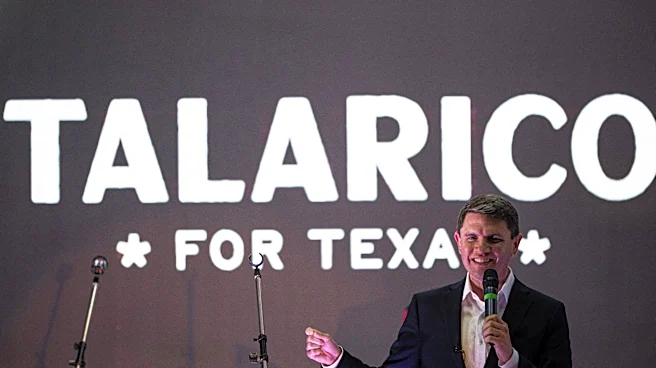
Texas Democratic U.S. Senate nominee James Talarico has publicly stated his opposition to transgender student-athletes competing in girls' sports 'if it risks safety or fairness,' marking a shift from his previous legislative record. As a state representative,
Talarico had voted against Republican restrictions on trans athletes. He explained his past votes by stating that the bills were 'overly broad' and that he supported amendments that would have given decision-making power to local communities. Talarico also walked back previous comments made in 2021, where he suggested there were six biological sexes, now affirming there are two sexes with a small percentage of people having genetic differences. He clarified that his past remark about God being nonbinary was meant to be provocative, emphasizing that no human category fully captures God. These adjustments come as Talarico seeks to appeal to a broader electorate in his bid for a statewide win in Texas.
Why It's Important?
Talarico's modified stance is significant in the context of the ongoing national debate surrounding transgender rights, particularly in sports and gender identity. His shift reflects the complex political landscape where candidates often navigate between appealing to their base and attracting moderate voters. For the LGBTQ+ community and its advocates, this change may be seen as a setback or a pragmatic political move, potentially impacting their support. For conservative voters, it might be viewed as a more aligned position. The issue of transgender athletes in sports has become a prominent cultural and political battleground, and Talarico's evolving position highlights the pressure politicians face to define their stance on these sensitive topics. His comments also underscore the challenges of discussing complex biological and social issues in a political arena, where nuances can be easily lost or weaponized.
What's Next?
Talarico's updated positions will likely continue to be scrutinized by both his Republican opponent, Attorney General Ken Paxton, and LGBTQ+ advocacy groups. Paxton has already criticized Talarico's shift as inconsistent with his legislative record, framing it as a 'flip-flop.' This issue is expected to remain a key talking point in the Texas Senate race, influencing voter perceptions and campaign strategies. Talarico will likely need to further clarify his nuanced position to both his base and potential swing voters. The broader political discourse around transgender rights in sports will continue, with other candidates and policymakers potentially adjusting their own stances as public opinion and political pressures evolve. This could also lead to more detailed policy proposals that attempt to balance fairness in sports with inclusivity.
Beyond the Headlines
The deeper implications of Talarico's evolving stance touch upon the broader societal struggle to reconcile traditional views of gender and biology with contemporary understandings of gender identity. His comments about God being nonbinary, and his subsequent clarification, reflect a tension between theological interpretations and modern social constructs. This political maneuvering also highlights how deeply cultural issues are intertwined with electoral politics, often forcing candidates to make difficult choices that can alienate some while appealing to others. The debate over transgender athletes is not just about sports; it's a microcosm of larger societal questions about identity, fairness, and the role of government in regulating personal and social norms. The long-term impact could be a continued re-evaluation of how these issues are discussed and legislated, potentially leading to more nuanced policies or further polarization depending on how political leaders navigate these complex terrains.