






What's Happening?
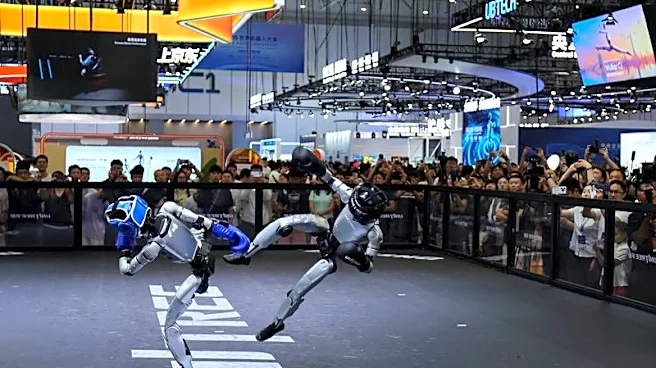
The second World Humanoid Robot Games has commenced at the National Speed Skating Oval in Beijing, featuring an expanded program of sporting and real-world challenges. The five-day event will host over 2,000 robots from various countries, participating
in 51 events and 1,301 competitions across nine sessions. This marks a significant increase from the inaugural games, which had three days and six sessions. The program integrates athletic competitions, artistic performances, and practical applications. Among the 51 events, 30 are competitive sports and 21 are scenario-based challenges. New additions to the competition include tug-of-war and weightlifting, which are making their debut. The games also incorporate traditional Chinese sports such as Taijiquan and Touhu (pitch-pot). Ball sports have been expanded beyond football to include table tennis and tennis, designed to test the robots' fine motor control, autonomous perception, and real-time decision-making capabilities. One notable participant, a humanoid robot named Lightning, developed by Chinese smartphone maker Honor, reportedly ran 100 meters in 9.32 seconds during a preparatory test event, surpassing Usain Bolt's human world record of 9.58 seconds.
Why It's Important?
The World Humanoid Robot Games highlights the rapid advancements in robotics and artificial intelligence, showcasing the increasing capabilities of humanoid robots in both athletic and practical domains. The expansion of events, particularly those requiring fine motor skills and real-time decision-making like table tennis, signifies a leap in robotic dexterity and cognitive functions. The reported achievement of the 'Lightning' robot in outperforming a human 100-meter sprint record underscores the potential for robots to exceed human physical limits in specific tasks, pushing the boundaries of what is considered possible for autonomous machines. This event serves as a critical platform for stress-testing robot hardware and software, driving innovation in areas such as joint motors, reducers, and control algorithms. The inclusion of traditional Chinese sports also demonstrates an effort to integrate cultural elements into technological showcases, potentially broadening the appeal and application of robotics. The games contribute to China's strategic promotion of humanoid robots as a key emerging industry, with implications for manufacturing, logistics, and consumer applications globally.
What's Next?
The ongoing World Humanoid Robot Games will continue to feature various competitions, with engineers and researchers likely to analyze the performance data to further refine robot designs and algorithms. The introduction of new high-intensity, contact-heavy events like tug-of-war and weightlifting will provide valuable insights into the structural integrity and robustness of humanoid robots. The focus on autonomous perception and real-time decision-making in ball sports suggests future developments will prioritize more sophisticated AI integration. Following the games, the insights gained from these diverse challenges are expected to accelerate the deployment of humanoid robots in various real-world scenarios, including industrial automation, service sectors, and potentially even entertainment. The event's accessible ticket pricing aims to foster public engagement and interest in robotics, potentially inspiring future generations of engineers and researchers. The continuous iteration and improvement demonstrated at these games will likely lead to more advanced and versatile humanoid robots in the coming years.
Beyond the Headlines
Beyond the immediate competitive aspect, the World Humanoid Robot Games reflects a deeper global trend towards integrating advanced robotics into society. The event serves as a proving ground not only for individual robot capabilities but also for the entire ecosystem of robot development, from research and manufacturing to testing and deployment. The emphasis on stress-testing machines and pushing their physical and cognitive limits highlights the ongoing quest to create robots that can operate effectively in complex, unstructured environments. The reported speed of the 'Lightning' robot, while impressive, also raises questions about the future of human-robot interaction and competition, potentially blurring the lines between human and machine achievements in various fields. The event's role in showcasing China's rapid advancements in robotics positions the country as a significant player in the global AI and robotics landscape, potentially influencing international standards and collaborations. The broader implications include ethical considerations surrounding autonomous decision-making, the impact on labor markets, and the societal acceptance of increasingly capable humanoid machines.