



What's Happening?
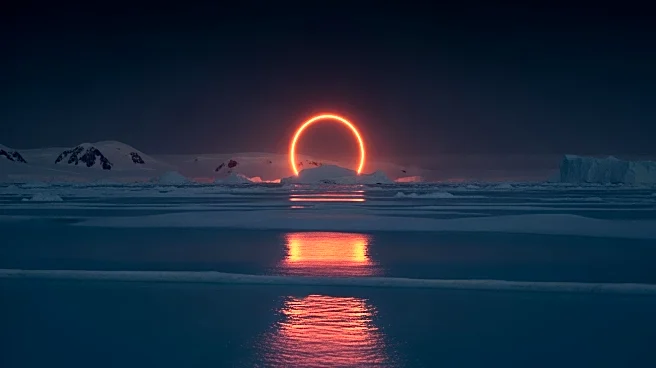
A rare annular solar eclipse is set to occur over Antarctica, creating a 'ring of fire' effect visible only from a narrow, uninhabited stretch of the continent. This celestial event will take place on February 17, 2026, and will be fully visible only from two
inhabited locations: Concordia Station, a French-Italian base, and Mirny Station, operated by Russia. The eclipse will last for a brief period, with Concordia experiencing 2 minutes and 1 second of annularity and Mirny 1 minute and 52 seconds. The extreme location and limited visibility zone mean that only a handful of researchers and adventurers might witness the full spectacle. A partial eclipse will be visible over a larger region, including parts of southern Africa, South America, and surrounding oceans.
Why It's Important?
This event is significant due to its rarity and the unique viewing conditions it presents. The eclipse offers a rare opportunity for scientific observation and public interest in celestial phenomena. For researchers stationed in Antarctica, it provides a chance to study the effects of such an eclipse in extreme conditions, including potential impacts on local weather patterns. The event also highlights the challenges of accessing remote areas for scientific and tourism purposes, as the locations within the eclipse's path are not equipped to accommodate tourists. This underscores the broader issue of accessibility and infrastructure in remote scientific outposts.
What's Next?
Following the eclipse, researchers may analyze data collected during the event to understand its impact on local atmospheric conditions. The eclipse-induced cooling effect, which can disrupt cloud formation, might offer insights into weather patterns in polar regions. Additionally, the event could spark interest in future expeditions to remote areas for scientific and tourism purposes, potentially leading to discussions on improving infrastructure and accessibility in such regions.
Beyond the Headlines
The eclipse highlights the intersection of science and tourism, as rare celestial events often draw interest from both communities. It raises questions about the environmental impact of increased human activity in fragile ecosystems like Antarctica. The event also serves as a reminder of the importance of international collaboration in scientific research, as stations from multiple countries will be involved in observing the eclipse.