





What's Happening?
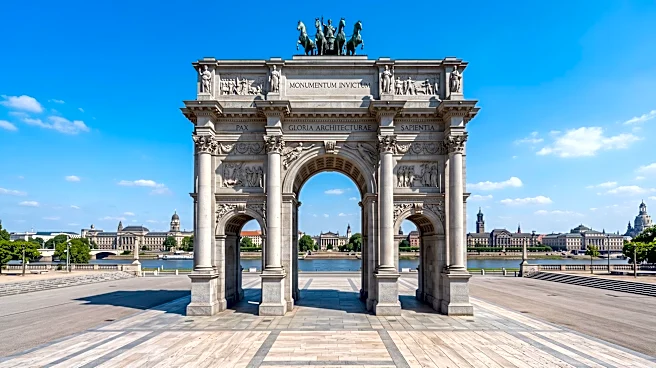
The US Department of Justice has indicated that the construction of a 250-foot (76-meter) triumphal arch, proposed by President Trump near Washington, could take between 33 to 39 months to complete if approved. This timeline suggests the arch would not
be finished before the end of President Trump's potential second presidential term, according to The Guardian. The project, which is modeled after the Arc de Triomphe in Paris, is planned for a location near Arlington National Cemetery in Virginia, across the Potomac River from Washington. The National Capital Planning Commission is scheduled to meet to consider approving the project, and the US Department of the Interior may issue a final decision on the same day. If approved, initial earthworks and foundation installation could begin as early as Thursday, with above-ground construction slated to start no earlier than May 2027. However, the project faces legal challenges, with Virginia and the District of Columbia filing a lawsuit against the National Park Service and the Department of the Interior to halt the work, citing a lack of congressional approval and legal grounds.
Why It's Important?
This development is significant due to the potential impact on federal land use, historical preservation, and inter-governmental relations. The lawsuits filed by Virginia and the District of Columbia highlight concerns over the project's legality and the alleged circumvention of congressional approval, which could set precedents for future federal construction projects. Furthermore, several veterans have also initiated legal action, arguing that the arch would disrupt the historic visual axis between the Lincoln Memorial and Arlington National Cemetery. This raises questions about the balance between new development and the preservation of national heritage sites and their symbolic significance. The government's argument that the arch's location and height could enhance capital protection against threats like drones introduces a national security dimension, potentially influencing future urban planning decisions in sensitive areas. The project also brings into focus the role of various federal agencies, such as the National Capital Planning Commission, the Department of the Interior, and the National Park Service, in approving and overseeing such large-scale developments.
What's Next?
The immediate next steps involve critical decisions from federal bodies and ongoing legal proceedings. The National Capital Planning Commission is scheduled to hold a meeting to consider approving the project, and concurrently, the US Department of the Interior may issue a final decision. The National Park Service could also issue a permit or other necessary documentation for the project's implementation. Simultaneously, the US District Judge for the District of Columbia, Tanya Chutkan, will consider the government's request to reject the lawsuit seeking to halt the work. The outcome of these legal challenges will be crucial in determining whether construction can proceed. Should the project receive approvals and overcome legal hurdles, the initial phase of earthworks and foundation installation could commence, followed by above-ground construction in May 2027. However, continued legal battles from state governments and veterans' groups could further delay or even permanently halt the project, leading to prolonged litigation and public debate over its necessity and appropriateness.
Beyond the Headlines
Beyond the immediate legal and logistical challenges, the proposed triumphal arch project touches upon deeper ethical and cultural implications regarding national memory and public space. The controversy surrounding its location, particularly its proximity to Arlington National Cemetery and its potential to obstruct the visual axis with the Lincoln Memorial, underscores a broader debate about how national symbols are created and integrated into existing historical landscapes. The project could be perceived by some as an attempt to imprint a specific political legacy onto the nation's capital, potentially sparking discussions about the appropriate use of public monuments and their role in reflecting collective national identity rather than individual political figures. The government's justification of the arch as a security measure against drone threats also raises questions about the evolving nature of urban defense and whether such monumental structures are effective or merely symbolic in addressing modern security concerns. This development could set a precedent for future proposals that blend monumental architecture with security functions, prompting a re-evaluation of urban planning in the context of national security and historical preservation.