
What's Happening?
Researchers have discovered natural 'brakes' within a seafloor fault in the eastern Pacific Ocean, which have been preventing larger earthquakes for over 30 years. The Gofar transform fault, located about
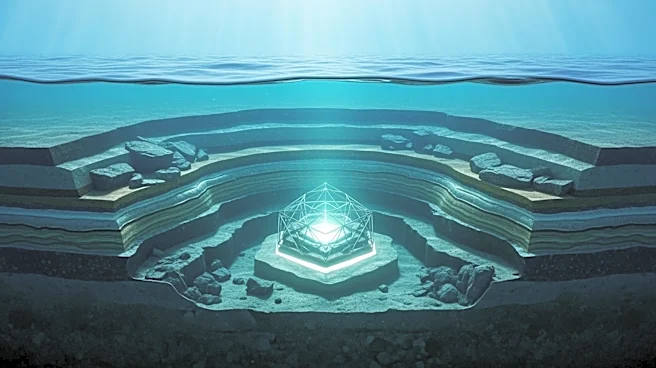
1,000 miles west of Ecuador, has been producing magnitude 6 earthquakes with remarkable regularity. These quakes occur every five to six years, rupturing nearly the same sections of the fault. A study published in the journal Science reveals that special regions within the fault act as natural braking systems, stopping earthquakes from growing larger. The research was conducted by a team from Indiana University Bloomington, Woods Hole Oceanographic Institution, and other institutions. They found that these 'barrier zones' are complex areas where the fault breaks into multiple strands, creating conditions for 'dilatancy strengthening,' which slows or stops ruptures.
Why It's Important?
The discovery of these natural 'brakes' has significant implications for earthquake science and hazard forecasting. Transform faults like Gofar are common in Earth's oceans, and understanding their behavior can help improve models used to estimate seismic hazards. This could be particularly beneficial for regions near major coastal populations, where underwater earthquakes pose a risk. The findings suggest that similar barrier zones may exist across the ocean floor, potentially acting as a widespread system of natural earthquake brakes. This knowledge could lead to better preparedness and mitigation strategies for communities vulnerable to seismic activity.
What's Next?
The research team plans to further investigate the presence of similar barrier zones in other oceanic transform faults. This could involve deploying more ocean bottom seismometers to gather detailed seismic data. The goal is to refine earthquake models and improve predictions of seismic hazards. Additionally, understanding the role of these natural 'brakes' could inform engineering practices and policy decisions related to earthquake preparedness and infrastructure resilience.
Beyond the Headlines
The study highlights the complex interplay between geological structures and seismic activity. It underscores the importance of interdisciplinary research in uncovering the mechanisms that govern natural phenomena. The findings also raise questions about the potential for human intervention in managing seismic risks, such as through engineering solutions that mimic natural braking systems. This could open new avenues for research and innovation in earthquake science.