




What's Happening?
Solar farm development in Illinois is currently embroiled in legal disputes across Will, Grundy, and Winnebago counties, stemming from conflicting interpretations of state law regarding local authority over agricultural land. Five months ago, the Will County
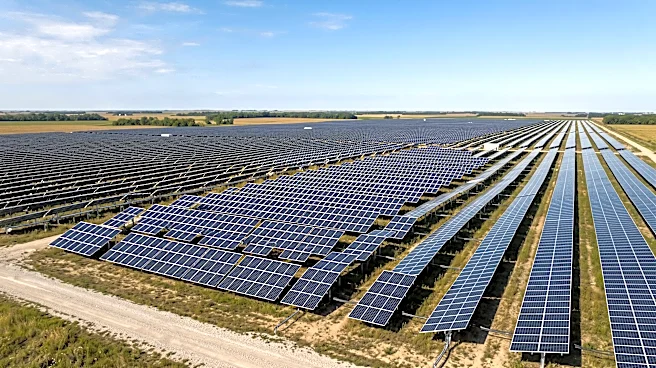
Board was compelled by a court order to approve six solar farm projects it had previously rejected. This reversal was based on a Third District appellate court ruling that limited county officials' discretion over solar farms in agricultural zones. However, a separate Fourth District appellate court has since ruled in favor of Winnebago County's decision to block a solar farm, granting that county board more authority. This creates a legal schism, with Grundy County appealing the Third District ruling, and the villages of Shorewood and Channahon challenging the forced approvals in Will County. Additionally, a group of Will County residents has filed a lawsuit against a 6,100-acre solar project, alleging that the state law mandating its approval violates their due process rights. The project, referred to as the 'largest solar industrial project in the state of Illinois,' spans non-contiguous parcels across three townships.
Why It's Important?
These ongoing legal battles are critical for defining the future landscape of solar energy development and local governance in Illinois. The conflicting appellate court decisions highlight a fundamental tension between state-level renewable energy mandates and local land-use control. If the Third District's interpretation prevails, it could significantly diminish the ability of county boards to regulate large-scale solar projects, potentially leading to more rapid solar farm expansion but also increased local opposition and concerns about agricultural land preservation. Conversely, if the Fourth District's stance is upheld, it would empower local authorities to have a greater say in such developments, potentially slowing down renewable energy projects but addressing community concerns more directly. The outcome will impact property owners, solar developers, and the state's energy policy, determining who holds the ultimate authority in balancing agricultural interests with renewable energy goals. The legal uncertainty also creates an unpredictable environment for investment in solar infrastructure within the state.
What's Next?
The legal disputes are expected to escalate to the Illinois Supreme Court, given the conflicting decisions from the appellate courts. Attorney James Murphy, representing Winnebago County, Grundy County, Shorewood, and Channahon, anticipates that the Supreme Court will take up one or both petitions for leave to appeal. The court's agenda for such cases is typically released in late September. Until the Illinois Supreme Court issues a definitive ruling, the Third District Appellate Court's decision, which limits local authority over solar farm approvals, remains the governing law in Will County. This means that, for now, Will County must abide by the previous court-ordered approvals. The Supreme Court's decision will be pivotal in clarifying the extent of local discretion versus state mandates concerning solar farm development on agricultural land across Illinois. Stakeholders, including solar developers, county boards, and local residents, will be closely watching the Supreme Court's actions, as its ruling will establish a precedent for future renewable energy projects in the state.
Beyond the Headlines
The legal complexities surrounding solar farm development in Illinois extend beyond immediate project approvals, touching upon deeper issues of property rights, environmental stewardship, and the balance of power between state and local governance. The lawsuit filed by Will County residents, alleging a violation of due process rights due to state-mandated approvals, underscores a growing concern among communities about the perceived erosion of local control in the face of large-scale industrial projects. This conflict highlights the challenge of implementing statewide energy policies while respecting the autonomy and specific needs of local communities. Furthermore, the debate over using agricultural land for solar farms raises questions about food security, land use efficiency, and the long-term ecological impact of converting productive farmland. The Supreme Court's eventual decision could set a significant precedent for how similar conflicts are resolved in other states, influencing the national conversation on renewable energy infrastructure and local land-use planning. It also brings to light the ethical considerations of eminent domain or similar mechanisms when private land is deemed essential for public energy goals.