
What's Happening?
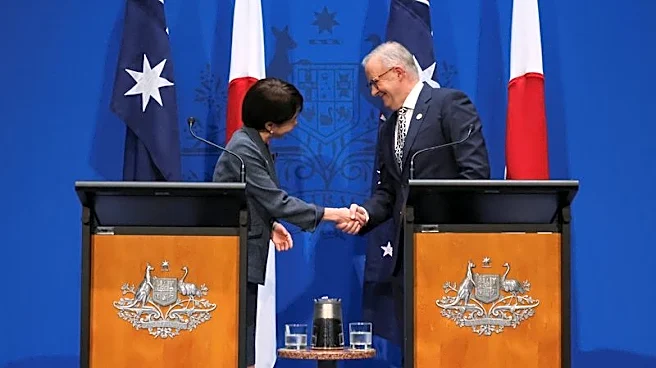
The prime ministers of Japan and Australia have agreed to enhance cooperation in energy security, defense, and critical minerals. This decision comes as global supply chains face disruptions due to conflicts
in the Middle East, particularly the Iran war. Japanese Prime Minister Sanae Takaichi and Australian Prime Minister Anthony Albanese met in Australia to discuss strategic issues, including China's influence and North Korea's actions. The agreements aim to mitigate the impact of the Strait of Hormuz's effective closure on the Indo-Pacific region. Australia, a major supplier of liquefied natural gas to Japan, seeks to ensure stable energy supplies. The countries also plan to counter China's control over rare earth minerals, crucial for defense and electric vehicle industries.
Why It's Important?
The strengthened cooperation between Japan and Australia is significant for regional stability and economic security. By collaborating on energy and critical minerals, both nations aim to reduce vulnerability to global shocks, such as those caused by Middle Eastern conflicts. This partnership also addresses concerns over China's dominance in rare earth minerals, which are vital for various industries. The agreements could lead to more resilient supply chains and enhanced defense capabilities, benefiting both countries' economies and security. Additionally, the collaboration may influence geopolitical dynamics in the Indo-Pacific, as Japan and Australia position themselves as key players in countering regional threats.
What's Next?
The agreements set the stage for further collaboration between Japan and Australia, particularly in defense and energy sectors. Both countries are likely to continue discussions on strategic issues, including responses to geopolitical tensions and economic coercion. The partnership may also lead to joint projects in critical minerals, with Australia providing financial support for initiatives involving Japan. As the global landscape evolves, Japan and Australia will likely seek to strengthen their alliance further, potentially influencing regional policies and international relations.