
What's Happening?
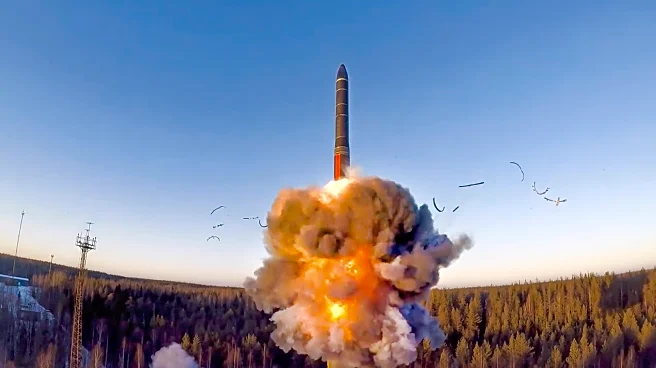
A recent Pentagon report has highlighted China's significant advancements in its nuclear counterstrike capabilities. The report details the construction of three new silo fields in China, each capable
of housing approximately 100 missiles. This development is part of China's broader strategy to enhance its nuclear deterrence and counterstrike capabilities in the event of a nuclear conflict. The Chinese government maintains that its nuclear arsenal is for self-defense and is kept at a minimum level necessary for national security. The Pentagon's assessment indicates that China is rapidly modernizing its nuclear forces, aiming to challenge the United States with a 'world-class' military. This includes the deployment of long-range missiles capable of reaching global targets and penetrating defense systems. Additionally, China has reportedly expanded its space-based early warning systems to detect incoming missile threats more effectively.
Why It's Important?
The expansion of China's nuclear capabilities is significant as it represents a shift in the global nuclear balance, potentially increasing tensions between major powers. With over 600 warheads currently and projections to exceed 1,000 by 2030, China's growing arsenal poses a strategic challenge to the United States and its allies. The Pentagon's report suggests that China's military buildup could make the U.S. homeland more vulnerable to nuclear threats. This development underscores the importance of international arms control agreements and the need for dialogue between nuclear-armed states to prevent escalation and ensure global security. The Chinese government's response to the report, expressing dissatisfaction and opposition, highlights the geopolitical tensions and differing perspectives on military expansion and security.
What's Next?
The future implications of China's nuclear expansion remain uncertain. While China maintains a no-first-use policy, the potential loading of additional intercontinental ballistic missiles in its new silos could further enhance its counterstrike capabilities. This development may prompt the United States and other nations to reassess their nuclear strategies and defense postures. Diplomatic efforts and negotiations on arms control could become increasingly important to address the growing nuclear capabilities and prevent an arms race. The international community will likely continue to monitor China's military developments closely, seeking ways to engage in constructive dialogue and reduce the risk of conflict.