





What's Happening?
The vocabulary of American cowboys and rodeos is significantly influenced by words of Spanish origin, reflecting a rich history of cultural exchange in the American South. Terms like 'buckaroo,' derived from the Spanish 'vaquero,' and 'rodeo,' from 'rodear,'
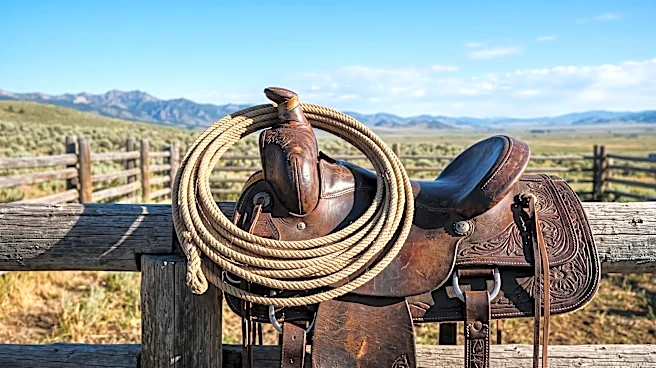
illustrate how Spanish cattle-herding traditions were adopted and integrated into English. Other examples include 'jerky,' originating from the Quechua word 'ch'arki' via Spanish 'charqui,' and 'bronco,' from the Spanish word for 'rough' or 'rude,' used for wild horses. Essential tools and techniques also retain Spanish roots, such as 'lasso' from 'lazo' and 'lariat' from 'la reata.' Even 'mustang' comes from 'mesteño' or 'mestengo,' referring to free-roaming horses, and 'stampede' is a calque of the Spanish 'estampida.'
Why It's Important?
This linguistic integration is important as it highlights the profound historical and cultural impact of Spanish-speaking communities, particularly Mexican vaqueros, on the development of American Western culture. It demonstrates how practical knowledge and terminology were transferred across cultures, shaping an iconic American identity. The persistence of these words in everyday cowboy lingo underscores a shared heritage in cattle rearing and frontier life, revealing that American culture is a tapestry woven from diverse influences. Understanding these origins enriches our appreciation of language evolution and the interconnectedness of cultures, moving beyond a simplistic view of American history to acknowledge its complex, multicultural foundations.
What's Next?
The continued use and study of these Spanish-derived terms will likely reinforce the recognition of Hispanic contributions to American culture and history. Educational initiatives and historical research may further explore these linguistic connections, providing deeper insights into the cultural exchanges that shaped the American West. As awareness grows, there may be increased efforts to preserve and celebrate these linguistic legacies, potentially influencing how cowboy culture is portrayed in media, literature, and historical accounts. This ongoing linguistic heritage will continue to serve as a tangible link to the past, reminding us of the diverse origins of American traditions.
Beyond the Headlines
The deeper implication of these linguistic borrowings extends to the broader understanding of American identity. It challenges narratives that might overlook the significant contributions of non-English-speaking cultures to the formation of the United States. The adoption of words like 'buckaroo' and 'bronco' is not merely about vocabulary; it represents the assimilation of practices, skills, and a way of life that were essential to the development of the American frontier. This cultural fusion illustrates how language acts as a living archive, preserving the stories of interaction, adaptation, and mutual influence between different groups. It encourages a more inclusive view of American history, recognizing the foundational role of diverse communities in shaping the nation's character and traditions.