





What's Happening?
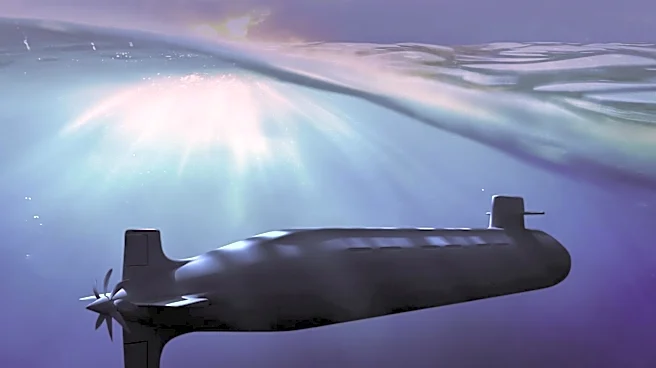
The US Navy's Orca Extra Large Uncrewed Undersea Vehicle (XLUUV), the largest drone submarine in its fleet, successfully completed a voyage exceeding 1,000 nautical miles in the eastern Pacific in July. This marks the first time an XLUUV-class system
has achieved such a long-distance autonomous mission. The Orca is designed for extended endurance, with a maximum range of 6,500 nautical miles, utilizing diesel-electric propulsion and surfacing only for battery recharging. It is equipped for various missions including surveillance, mine warfare, reconnaissance, seabed operations, and expeditionary support, aligning with the Pentagon's strategy to integrate unmanned systems into carrier strike groups. Despite this milestone, the Orca program, which has seen an $885 million investment over eight years, faces significant uncertainty regarding its designation as an official program of record, according to a Government Accountability Office (GAO) report.
Why It's Important?
The successful long-range voyage of the Orca XLUUV demonstrates a critical advancement in the US Navy's unmanned undersea capabilities, particularly for operations in the vast Pacific Theater. Its ability to conduct extended missions without human intervention could significantly enhance naval flexibility, reduce risks to manned vessels, and provide persistent presence in contested environments. The integration of such large drone submarines could revolutionize naval warfare by enabling new tactics for surveillance, mine laying, and logistical support. However, the program's uncertain future, despite substantial investment and technical achievements, highlights challenges in defense acquisition, including technical hurdles related to autonomy, battery endurance, and navigation. The Navy's reliance on Boeing for proprietary software adjustments also raises concerns about long-term adaptability and cost-effectiveness, potentially impacting the broader strategy of unmanned systems integration.
What's Next?
The US Navy is awaiting a decision on whether the Orca XLUUV will be designated as an official program of record, which will determine its long-term funding and production path. The remaining five prototypes are now expected to be delivered by the end of 2026, a three-month delay from earlier projections, as the program continues to address technical challenges. The Navy will need to evaluate the cost-effectiveness and operational benefits of the Orca against its development hurdles and proprietary software limitations. Future developments will likely focus on refining its autonomous capabilities, payload integration, and interoperability with existing naval assets. The success or failure of the Orca program could influence future investments and strategies for unmanned undersea vehicles across the US military, impacting the pace of technological adoption in naval warfare.
Beyond the Headlines
The Orca XLUUV represents a pivotal step in the evolution of naval power, moving towards a future where unmanned systems play an increasingly central role. Beyond its immediate military applications, the development of such advanced autonomous underwater vehicles raises broader questions about maritime ethics, international law regarding unmanned warfare, and the potential for a new arms race in undersea technology. The challenges faced by the Orca program also reflect the broader complexities of integrating cutting-edge technology into established military structures, including issues of procurement, maintenance, and operational doctrine. The success of these systems could redefine naval strategy, shifting focus from large, expensive manned platforms to a more distributed, autonomous fleet, with profound implications for global maritime security and power projection.